Disclosure: Some links in this article are affiliate links. If you book through them, I may earn a small commission at no extra cost to you. I only recommend places and experiences I genuinely think are worth it.
I’ve lived in Lisbon for years, and one of my favourite things to do is show visitors around the city. Something I’ve noticed time and time again is that people often fall in love with Lisbon before they understand it.
They admire the yellow trams, photograph the blue tiles, wander through Alfama’s maze of streets and watch the sunset from a miradouro. But they rarely know why any of it looks the way it does.
That’s a shame, because Lisbon isn’t just a beautiful city—it’s a city that tells a story.
Over the years, whether I’m exploring on my own or walking the streets with friends and visitors, I’ve realised that the little details are often the most fascinating. The colour of the rooftops. The patterns beneath your feet. The reason churches appear around every corner. Even the direction the city faces.
Once you know what to look for, Lisbon begins to make sense.
This guide isn’t about checking landmarks off a list. It’s about helping you read the city the way I’ve learned to read it after years of living here. By the end, I hope you’ll never walk through Lisbon in quite the same way again.
👉 See how Lisbon’s story unfolds across more than 3,000 years.
Table of Contents
- Introduction: Learn to Read Lisbon Like a Local
- Why Is Everything Facing the River?
- Why Is Lisbon Built on Seven Hills?
- Why Are There So Many Viewpoints (Miradouros)?
- Why Are the Streets So Narrow?
- Why Does Baixa Look So Organised?
- Why Are Lisbon’s Streets Black and White?
- Why Are Blue Tiles Everywhere?
- Why Are So Many Buildings Painted in Bright Colours?
- Why Are Lisbon’s Rooftops Almost All Red?
- Why Are There Churches on Almost Every Corner?
- Why Are There So Many Monasteries?
- Why Are Portuguese Explorers Celebrated Everywhere?
- Why Is Belém Such an Important Part of Lisbon?
- Why Is Praça do Comércio So Grand?
- Why Are Lisbon’s Trams Still Climbing the Hills?
- Why Does Lisbon Have Public Elevators?
- Why Are Historic Fountains Found Across the City?
- Why Do So Many Buildings Have Wrought-Iron Balconies?
- Why Does Lisbon Have Such Extraordinary Light?
- Why Is Street Art Part of Lisbon’s Identity?
- Why Are There So Many Small Squares (Largos)?
- Why Does Alfama Feel So Different from the Rest of Lisbon?
- Why Is Fado So Closely Connected to the City?
- Why Does Lisbon Blend So Many Architectural Styles?
- Why Does Lisbon Feel Like a City That Has Been Rebuilt Again and Again?
- Final Thoughts: Once You Learn to Read Lisbon, You’ll Never See It the Same Way Again
- Frequently Asked Questions
Reading Lisbon
Most people visit Lisbon. Few people actually read it.
Walk through Lisbon for the first time and you’ll notice colourful tiles, steep streets, old trams, grand squares and spectacular viewpoints. They’re beautiful—but they’re also clues.
Every building, pavement, monument and neighbourhood tells part of a story stretching back over 2,000 years. Once you understand what you’re looking at, the city transforms. Suddenly those blue tiles aren’t just decoration. The hills aren’t simply inconvenient. Even the shape of the streets begins to make sense.
Think of this guide as learning a new language. By the end, you’ll be able to “read” Lisbon like a local historian.

25 Things You’ll Notice Once You Know the City’s History
1. Why Is Everything Facing the River?
The River Tagus isn’t just scenery—it’s the reason Lisbon exists.
Long before modern roads, the Tagus was Portugal’s greatest highway. Phoenician traders, Romans, Moors and Portuguese explorers all arrived by water. For centuries, the river connected Lisbon to Africa, Asia and the Americas.
That’s why some of the city’s most important landmarks line the waterfront:
- Praça do Comércio
- Cais do Sodré
- Belém
- The Monument to the Discoveries
- MAAT
- Ribeira das Naus
The river wasn’t the edge of the city.
It was its front door.
Don’t miss: A sunset cruise or riverside walking tour makes it much easier to appreciate how Lisbon developed around the Tagus.
👉 The best way to get a lay of the land is to take a walking tour of Lisbon’s downtown.
2. Why Are There Seven Hills?
Lisbon loves reminding visitors it’s built on seven hills.
Whether there are exactly seven depends on who you ask, but the steep landscape shaped everything about the city—from neighbourhoods to transport.
The hills created natural defensive positions. Castles and churches were built on high ground, while merchants settled closer to the river.
Today, every climb rewards you with another spectacular panorama.
Once you realise the geography dictated the city’s growth, those steep streets suddenly feel much more logical.
👉 A tuktuk ride is the best way to explore Lisbon’s seven hills.
3. Why Are There So Many Viewpoints?
The Portuguese call them miradouros.
Rather than one famous viewpoint, Lisbon has dozens because every hill offers a different perspective.
Some face the castle.
Others overlook the river.
Some capture sunsets while others reveal hidden neighbourhoods.
The viewpoints became gathering places centuries before cameras existed. They were where people met, celebrated festivals and simply enjoyed the evening breeze.
Today they’re still some of Lisbon’s most loved public spaces.
👉 You can’t really experience Lisbonn without checking out the viewpoints.
4. Why Are the Streets So Narrow?
Walk through Alfama and you’ll notice streets that seem almost impossibly tight.
That’s because they were never designed for cars.
Much of Alfama follows the medieval street plan inherited from the Islamic period, when narrow winding lanes offered shade during hot summers and made invading armies easier to defend against.
These twisting alleys weren’t poor planning.
They were smart urban design—for another era.
5. Why Does Baixa Look Completely Different?
Leave Alfama and enter Baixa and suddenly everything changes.
The streets become straight.
The blocks become orderly.
The squares become enormous.
That’s because Baixa was almost entirely rebuilt after the devastating earthquake of 1755.
Under the direction of the Marquis of Pombal, Lisbon became one of Europe’s first examples of modern urban planning.
Instead of medieval chaos, the city gained a rational grid system designed for safety, commerce and efficiency.
It’s like walking from the Middle Ages straight into the Enlightenment.
6. Why Are the Streets Black and White?
Those beautiful wave-pattern pavements are called calçada portuguesa.
Made from black basalt and white limestone, they’re laid entirely by hand.
The designs range from simple geometric patterns to ships, sea monsters, flowers and giant mosaics.
Originally developed in the 19th century, Portuguese pavement spread across the country’s former empire and can now be found from Brazil to Macau.
Every step you take is literally walking across handcrafted public art.
7. Why Are There Blue Tiles Everywhere?
The famous azulejos are perhaps Lisbon’s most recognisable feature.
Despite popular belief, they didn’t originate in Portugal.
The word comes from the Arabic al-zulayj, meaning polished stone.
Initially influenced by Islamic decorative traditions, Portuguese artists gradually developed their own style, especially the iconic blue-and-white panels inspired by Chinese porcelain and Dutch ceramics.
Tiles weren’t simply decorative.
They helped insulate buildings, protected walls from moisture and told stories through enormous painted scenes.
Some buildings are essentially open-air museums.
👉 Ceramics and tile-painting workshops are one of the most immersive experiences in Lisbon.
8. Why Are So Many Buildings Painted Different Colours?
Pastel yellow.
Soft pink.
Ochre.
Mint green.
These cheerful façades weren’t just chosen because they look pretty.
Historically, colour helped distinguish buildings before modern street numbering became widespread.
It also reflected changing architectural fashions and made neighbourhoods feel lively rather than uniform.
Combined with colourful tiles, Lisbon developed one of Europe’s most distinctive cityscapes.
9. Why Are the Roofs Almost All Red?
Terracotta roof tiles dominate Lisbon for practical reasons.
Clay was widely available, durable and well suited to Portugal’s climate.
The warm reddish tones also became part of the city’s identity, creating the beautiful contrast visitors notice between white walls, colourful façades and deep blue skies.
The best way to appreciate this sea of rooftops is from one of Lisbon’s many miradouros.
10. Why Are Churches Everywhere?
Portugal has been deeply Catholic for centuries.
Churches weren’t simply places of worship.
They were schools, community centres, hospitals, meeting places and symbols of local identity.
Many neighbourhoods developed around parish churches, while monasteries once occupied enormous areas of the city.
Some of Lisbon’s most impressive buildings began life as religious institutions long before becoming museums or cultural venues.
11. Why Are There So Many Monasteries?
Portugal’s Age of Discovery created immense wealth.
Kings used that wealth to fund magnificent religious buildings as expressions of gratitude, faith and royal power.
The result was some of Europe’s finest monastic architecture.
Many survive today as UNESCO-listed landmarks and offer remarkable insight into Portugal’s golden age.
12. Why Are Explorers Everywhere?
You’ll constantly encounter statues of navigators, sailors and explorers.
This isn’t coincidence.
For a relatively small country, Portugal played an extraordinary role in global exploration during the 15th and 16th centuries.
Figures like Vasco da Gama became national heroes because their voyages reshaped global trade, navigation and geography.
Whether viewed as remarkable achievements, controversial chapters of colonial history, or both, these figures remain central to understanding Lisbon.
👉 Take a walking tour of Belem to learn all about Portugaç’s seafaring past.
13. Why Is Belém So Important?
Belém wasn’t originally part of central Lisbon.
It became the departure point for many Portuguese expeditions.
Imagine standing on the riverbank watching ships disappear for journeys that might last years—or never return.
Today Belém contains several of Portugal’s most significant monuments because this was where the Age of Discovery quite literally began.
It’s one of the most rewarding areas to explore on foot.
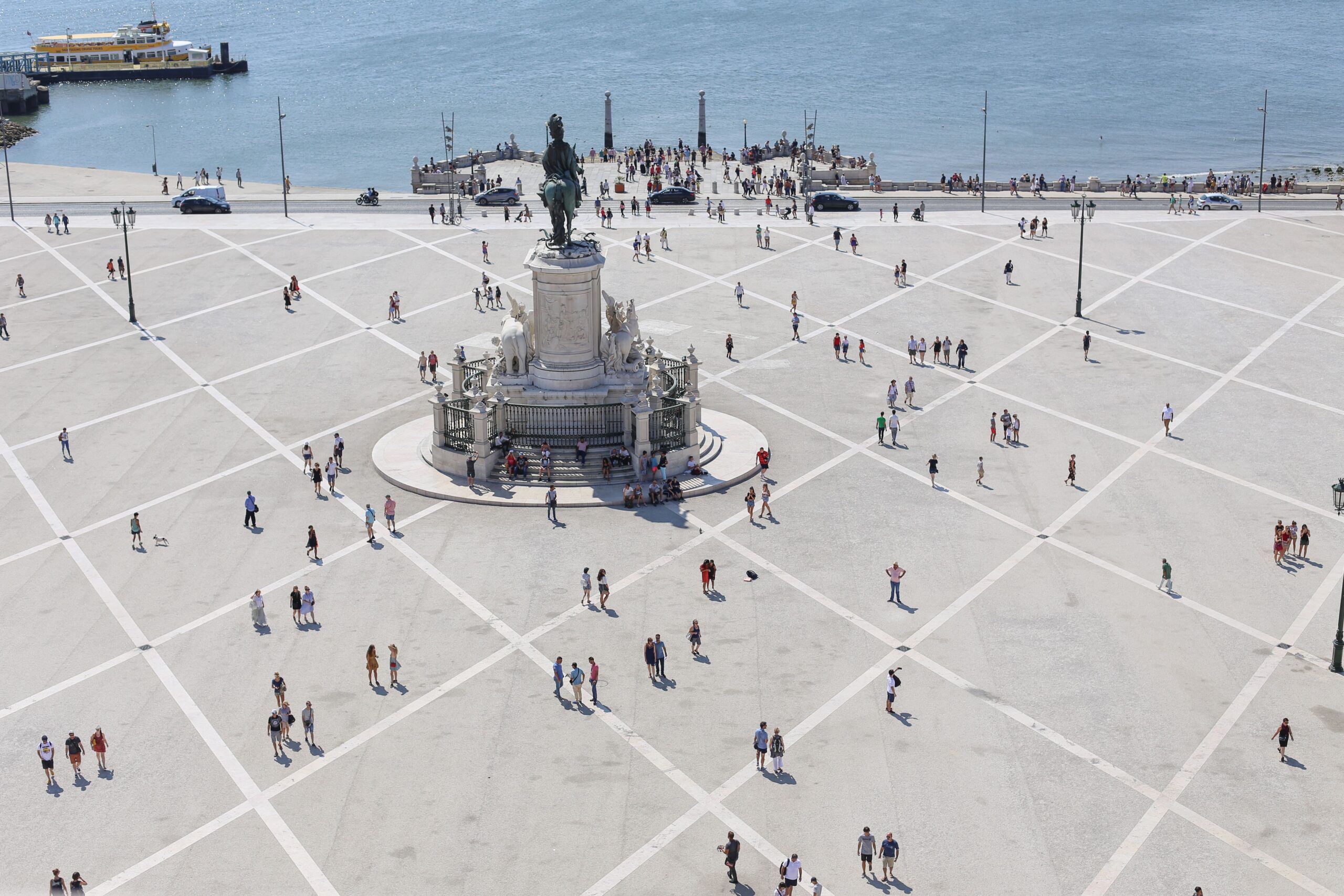
14. Why Is There a Giant Square Facing the Water?
Praça do Comércio was once the location of Portugal’s royal palace.
After the earthquake destroyed it, the area became Lisbon’s grand ceremonial entrance.
Visitors arriving by sea would step directly into one of Europe’s largest public squares.
It was designed to impress.
And it still does.
15. Why Are There Old Yellow Trams?
Lisbon’s famous trams weren’t introduced because they’re charming.
They were introduced because horses couldn’t efficiently climb many of the city’s steep streets.
Electric trams solved that problem at the end of the 19th century.
The iconic yellow colour came later and eventually became one of Lisbon’s defining symbols.
Even today, some routes continue through streets too narrow for modern vehicles.
16. Why Do Elevators Exist Between Streets?
Lisbon doesn’t just have lifts inside buildings.
It has public elevators connecting different levels of the city.
Rather than forcing everyone to climb endless hills, engineers built remarkable vertical transport systems linking neighbourhoods together.
They’re both practical infrastructure and fascinating pieces of industrial heritage.
17. Why Are There So Many Fountains?
Before modern plumbing, public fountains supplied drinking water.
They became social gathering places where neighbours met daily.
Many surviving fountains are surprisingly elaborate because providing fresh water was considered both practical and prestigious.
18. Why Do So Many Buildings Have Iron Balconies?
Those elegant wrought-iron balconies weren’t simply decorative.
They improved ventilation during hot summers, allowed residents to watch street life and reflected architectural influences spreading across Europe during the 18th and 19th centuries.
Lisbon’s streets have always been stages.
The balconies became front-row seats.
19. Why Does Lisbon Feel So Bright?
The city’s famous light has inspired painters, photographers and filmmakers for generations.
Several factors combine to create it:
- White limestone buildings
- The reflective Tagus River
- Clear Atlantic skies
- Bright Portuguese sunshine
- Pale stone pavements
Together they create an almost luminous quality unlike many European capitals.
20. Why Is There Street Art Beside Centuries-Old Buildings?
Lisbon embraces both preservation and reinvention.
You’ll often find contemporary murals beside medieval walls or abandoned factories transformed into creative spaces.
Rather than treating history as frozen, Lisbon continuously layers new stories onto old ones.
That’s one reason the city feels so alive.
21. Why Are There So Many Small Squares?
These neighbourhood squares, known as largos, developed organically where streets met or space opened around churches and markets.
Unlike grand plazas, they function as everyday living rooms for local communities.
Children play.
Neighbours chat.
Cafés spill onto the pavement.
Life happens here.
22. Why Does Alfama Feel Different From Everywhere Else?
Alfama survived the 1755 earthquake better than much of Lisbon because of its rocky foundations.
As a result, it preserves the closest glimpse of medieval Lisbon you’ll find today.
Its maze-like streets, staircases and tiny courtyards reveal what much of the city once looked like.
Walking here is travelling back several centuries.
23. Why Does Fado Belong Here?
Fado emerged from Lisbon’s working-class neighbourhoods, particularly Alfama and Mouraria.
Its songs reflect longing, separation, love and everyday life.
Whether performed in intimate taverns or concert halls, Fado remains one of the city’s most powerful cultural traditions.
Understanding the surrounding neighbourhoods makes the music even more meaningful.
24. Why Does Lisbon Mix So Many Architectural Styles?
Roman ruins.
Medieval walls.
Gothic churches.
Manueline masterpieces.
Baroque palaces.
Pombaline streets.
Art Nouveau buildings.
Contemporary museums.
Instead of replacing older architecture, Lisbon often built beside it.
The city became an architectural timeline you can walk through in a single afternoon.
25. Why Does Lisbon Feel Like a City That Has Been Rebuilt Again and Again?
Perhaps the most important thing to notice is that Lisbon isn’t defined by one moment in history.
It has been shaped by Phoenicians, Romans, Visigoths, Moors, Portuguese kings, devastating earthquakes, maritime expansion, political revolutions and modern renewal.
Every generation left something behind.
That’s why Lisbon feels layered rather than uniform.
It’s a city that remembers.
And once you’ve learned to read those layers, you’ll never see it the same way again.

❓Frequently Asked Questions
❓What makes Lisbon so unique compared to other European cities?
Lisbon is one of Europe’s oldest capitals and has been shaped by over 2,000 years of history. Roman foundations, medieval Moorish streets, Gothic churches, Manueline monuments, elegant Pombaline avenues and modern architecture all exist within the same city. Combined with its dramatic hills, Atlantic light and riverside setting, Lisbon offers a character unlike anywhere else in Europe.
❓Why is Lisbon called the City of Seven Hills?
The nickname dates back centuries and was inspired by ancient Rome. While historians debate whether there are exactly seven hills, Lisbon’s steep landscape has undeniably influenced its neighbourhoods, viewpoints, transport and architecture. The hills are one of the defining features of the city.
❓Why are Lisbon’s streets paved in black and white?
The distinctive pavements are known as calçada portuguesa. Skilled artisans arrange small pieces of black basalt and white limestone into intricate patterns entirely by hand. These pavements are considered one of Portugal’s most recognisable artistic traditions and can be found throughout Lisbon.
❓Why are Portuguese tiles called azulejos?
The word azulejo comes from the Arabic term al-zulayj, meaning “polished stone.” Although tile-making techniques were introduced during the Islamic period, Portugal later developed its own distinctive style, particularly the famous blue-and-white painted panels that decorate churches, palaces and ordinary homes.
❓Why did the 1755 earthquake change Lisbon so dramatically?
On 1 November 1755, a powerful earthquake, followed by a tsunami and devastating fires, destroyed much of central Lisbon. The rebuilding effort led by the Marquis of Pombal created the orderly Baixa district, making Lisbon one of the first cities in Europe to be rebuilt using modern urban planning principles.
❓Why are there so many viewpoints in Lisbon?
Lisbon’s hills naturally create spectacular vantage points across the city and the River Tagus. Over time, many of these locations became landscaped terraces known as miradouros, where both locals and visitors gather to admire the views, especially at sunset.
❓Why do Lisbon’s trams still operate today?
The city’s historic trams remain one of the most practical ways to navigate Lisbon’s steep, narrow streets. While they have become an iconic attraction for visitors, they continue to serve residents on routes where larger buses would struggle to operate.
❓Why is Belém so important in Portuguese history?
Belém was the departure point for many of Portugal’s great voyages during the Age of Discovery. Explorers such as Vasco da Gama sailed from this area, helping establish Portugal as one of the world’s leading maritime powers during the 15th and 16th centuries.
❓Why does Alfama look so different from Baixa?
Alfama largely survived the 1755 earthquake and still preserves its medieval street layout, with narrow winding alleys and hidden courtyards. Baixa, by contrast, was almost completely rebuilt afterwards using a symmetrical grid plan that reflected Enlightenment ideals of order and safety.
❓Why are there so many churches in Lisbon?
For centuries, the Catholic Church played a central role in Portuguese society. Churches served not only as places of worship but also as centres of education, charity and community life. Many of Lisbon’s most impressive historic buildings began as monasteries or convents.
❓Why is Lisbon famous for its light?
Photographers and artists have long admired Lisbon’s exceptional natural light. The combination of white limestone buildings, reflective pavements, the wide River Tagus and abundant sunshine creates a luminous quality that gives the city its distinctive appearance throughout the year.
❓What is the best way to experience Lisbon’s history?
One of the best ways is simply to walk. Exploring neighbourhoods such as Alfama, Baixa, Chiado and Belém on foot allows you to notice the architectural details, public squares, viewpoints and monuments that reveal the city’s fascinating past. Museums and guided walks can provide additional context, but many of Lisbon’s greatest stories are written directly into its streets.
A Walking Challenge: Can You Read Lisbon?
You’ve reached the end of this guide—but in many ways, this is where the real experience begins.
Tomorrow, as you wander through Lisbon, try to forget about ticking attractions off a list. Instead, become a detective. Look a little closer. Ask yourself why things look the way they do.
You’ll be surprised how quickly the city starts revealing its secrets.
Your Lisbon Reading Challenge
See how many of these clues you can spot during your visit:
☐ Find three different styles of azulejos. Notice how some are simple geometric patterns while others tell stories through elaborate painted scenes.
☐ Look down at the pavement. Can you find a section of calçada portuguesa featuring waves, ships, flowers or another intricate design?
☐ Stand in Praça do Comércio and face the Tagus. Imagine arriving here by sailing ship 500 years ago. This was the grand entrance to Portugal’s capital for merchants, ambassadors and explorers from around the world.
☐ Ride one of Lisbon’s historic yellow trams. As it squeezes through impossibly narrow streets, notice how perfectly it fits a city that was built centuries before cars existed.
☐ Visit both Alfama and Baixa on the same day. Compare the winding medieval alleys of Alfama with the neat grid of Baixa. You’re walking through two very different chapters of Lisbon’s history.
☐ Climb to a miradouro. Look out over the rooftops and see if you can identify the city’s hills, church towers, castle walls and the ever-present River Tagus tying everything together.
☐ Count how many church bell towers you can see from a single viewpoint. You’ll quickly realise just how deeply religion shaped Lisbon’s skyline.
☐ Take in the rooftops. From above, notice the sea of terracotta tiles stretching across the city—a colour palette that has become one of Lisbon’s defining features.
☐ Find a monument to an explorer. Whether it’s Vasco da Gama, Prince Henry the Navigator or another figure from the Age of Discovery, think about the voyages that connected this small Atlantic nation to the wider world.
☐ Notice the light. Watch how it reflects off the river, the limestone buildings and the black-and-white pavements. It’s one of the reasons artists and photographers have been captivated by Lisbon for generations.
☐ Look for traces of the 1755 earthquake. In Baixa, admire the wide streets and orderly layout that emerged from one of Europe’s greatest urban reconstruction projects.
☐ Pause beside an old fountain or small square (largo). Imagine what everyday life was like here before running water, cars and smartphones. These places were once the social heart of every neighbourhood.
☐ End your day by the river. As the sun sets over the Tagus, remember that for centuries this wasn’t the edge of Lisbon—it was its gateway to the world.
The Secret to Seeing Lisbon
The first time you visit Lisbon, you see a beautiful city.
The second time, you start noticing patterns.
By the third, you begin to understand why everything is where it is.
The hills. The trams. The viewpoints. The churches. The tiled façades. The elegant squares. The winding streets. They aren’t random quirks or postcard-perfect decorations—they’re chapters in a story that has been unfolding for more than two millennia.
That’s the difference between simply visiting Lisbon and truly reading it.
And once you’ve learned its language, every walk becomes richer, every monument becomes more meaningful, and every neighbourhood tells a story waiting to be discovered.
So the next time someone asks you what makes Lisbon so special, don’t just tell them about the views or the trams.
Tell them it’s a city that speaks.
You just have to know how to listen.
Final Thoughts: The City Starts Speaking
Most travel guides tell you where to go.
History tells you why it looks the way it does.
The next time you notice blue tiles, black-and-white pavements, a yellow tram climbing impossibly steep streets or a viewpoint crowded at sunset, you’ll know you’re seeing more than beautiful scenery.
You’re seeing centuries of adaptation, ambition, faith, craftsmanship and resilience written into the city itself.
And that’s the real magic of Lisbon.
Once you learn how to read it, every walk becomes a history lesson hiding in plain sight.
Even after years of living in Lisbon, I still catch myself noticing something new.
Sometimes it’s a tiny detail in an old tiled façade that I’ve walked past dozens of times. Other days it’s the way the late afternoon light hits the rooftops, or how a particular viewpoint suddenly helps me understand why an entire neighbourhood grew where it did.
That’s one of the reasons I never get tired of showing people around this city. You can visit the same streets over and over again, yet each walk reveals another piece of Lisbon’s story.
If there’s one thing I hope you take away from this guide, it’s this: don’t rush.
Look up at the rooftops. Look down at the pavements. Step inside a church. Pause at a miradouro. Wander into a quiet square. Follow the river.
The famous landmarks are wonderful, but it’s often the little clues between them that make Lisbon unforgettable.
Once you start reading the city instead of simply sightseeing, you’ll discover that Lisbon isn’t just one of Europe’s most beautiful capitals—it’s one of its most fascinating.
I hope this guide helps you see it through new eyes. Enjoy exploring—and if you notice a detail that surprised you, I’d love to hear about it.
About the author
I’m Duncan, a Lisbon-based guide and writer who’s lived here for 11 years and taken hundreds of visitors around the city. I created Lisbon Listicles to share everything you need to know about Lisbon in clear, practical lists — from iconic sights to hidden gems — so you can plan your trip easily and make the most of your time here.
All recommendations are based on personal experience and the questions I hear most often from visitors.
Leave a Reply