Disclosure: Some links in this article are affiliate links. If you book through them, I may earn a small commission at no extra cost to you. I only recommend places and experiences I genuinely think are worth it.
Lisbon is a city that rewards curiosity. You can spend a morning wandering through narrow medieval streets, have lunch in a grand square surrounded by eighteenth-century architecture, and finish the afternoon beside the river where Portuguese explorers once set sail for some of the greatest voyages in history. Yet what makes Lisbon particularly fascinating is that these different experiences are not simply architectural contrasts. They are the result of centuries of history, migration, trade, religion, destruction and reinvention.
One of the things I always enjoyed about Lisbon when I lived there and worked as a tour guide was explaining how much the character of one neighbourhood could differ from the next. Visitors often see Alfama, Baixa, Chiado and Bairro Alto as convenient areas to explore, eat and drink. But each has a story that helps explain how Lisbon developed into the city we know today.
Some neighbourhoods grew organically around medieval castles and religious buildings. Others emerged as wealthy commercial districts, were rebuilt following catastrophic disasters or developed around Portugal’s maritime expansion. A few have changed almost beyond recognition, while others have managed to preserve something of their original character despite the pressures of modern tourism.
Understanding these stories also makes choosing where to stay, what to visit and how to explore Lisbon much easier. If you enjoy history, architecture and discovering places beyond the obvious tourist attractions, getting to know the city’s historic neighbourhoods is one of the most rewarding ways to experience the Portuguese capital.
In this guide, I’m taking a closer look at six of Lisbon’s most important and interesting neighbourhoods: Alfama, Mouraria, Baixa, Chiado, Belém and Bairro Alto. We’ll explore how they developed, the historical events that shaped them, what remains of their past and what makes each one worth visiting today.
Let’s start where much of Lisbon’s medieval story is still written into the streets.
👉 If you want to know more about Lisbon’s history, read my full guide.

The History of Lisbon’s Neighbourhoods
1. Alfama – The Medieval Heart of Lisbon
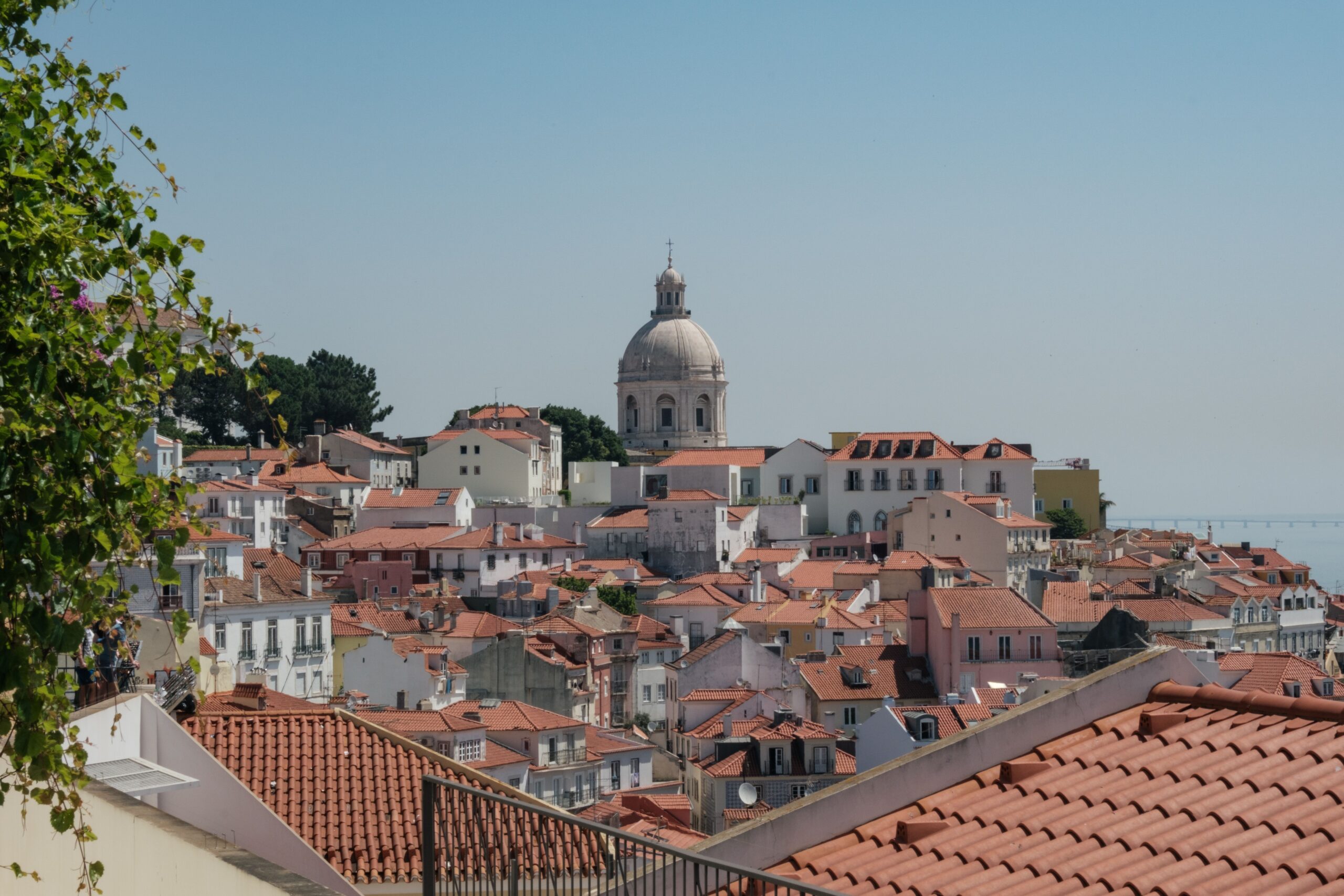
Of all Lisbon’s neighbourhoods, Alfama is perhaps the one that most readily transports visitors into the city’s distant past. Its labyrinth of narrow lanes, steep staircases, small squares and tightly packed houses feels a world away from the broad avenues and grand buildings of central Lisbon.
There is a reason for that. Alfama is one of the oldest continuously inhabited parts of the Portuguese capital, and its development stretches back well before Portugal became an independent kingdom.
The name Alfama is generally associated with the Arabic word al-hamma, referring to hot springs or baths. It is a fitting reminder of the neighbourhood’s Islamic past, although its history is considerably older.
From Roman settlement to Moorish Lisbon
Lisbon’s history stretches back more than two thousand years. The Romans established an important settlement here known as Felicitas Julia Olisipo, taking advantage of its strategic position beside the Tagus estuary.
The area around what is now Alfama formed part of this early settlement. Archaeological remains discovered in and around the neighbourhood provide evidence of Roman occupation, including buildings, streets and industrial activity.
Following the collapse of Roman authority in the western part of the empire, Lisbon passed through a succession of political and cultural changes. Visigothic rulers controlled the city before Muslim forces conquered it in 711.
Under Muslim rule, Lisbon became an important urban centre within Al-Andalus. The settlement expanded, its defensive structures were strengthened, and the area around the castle developed into a dense network of residential streets.
This is where Alfama’s distinctive layout began to take shape.
Unlike neighbourhoods developed according to carefully planned street patterns, the older parts of Alfama grew organically. Streets followed the contours of the hillside, connecting houses, courtyards, religious buildings and markets. The resulting maze was practical in a city where shade, shelter and defensive considerations mattered.
The influence of Islamic urban planning can still be felt in the neighbourhood today, although it would be misleading to suggest that every narrow street or architectural feature is Moorish in origin. Alfama has been altered and rebuilt many times over the centuries.
The Christian conquest of 1147
One of the defining events in Lisbon’s history took place in 1147, when King Afonso Henriques captured the city from its Muslim rulers with the assistance of crusaders travelling to the Holy Land.
The Siege of Lisbon lasted several months and ended in October 1147. The conquest marked a major turning point in the development of the Portuguese kingdom and established Lisbon as a Christian city under the expanding authority of Afonso Henriques.
The population changed considerably in the years that followed. Muslim inhabitants were displaced, converted, or gradually absorbed into a new social and religious order, while Christian settlers moved into the city.
Alfama remained an important residential district, and its position beneath the castle continued to give it strategic and social significance.
One of the best places to understand this period is the area surrounding Lisbon Cathedral (Sé de Lisboa). Construction began in 1147, shortly after the conquest, on or near the site of an earlier mosque.
The cathedral has undergone numerous alterations over the centuries, reflecting Romanesque, Gothic, Baroque and later architectural influences. It is not a perfectly preserved medieval building, but that is precisely what makes it interesting. Its different architectural layers tell the story of a city that has repeatedly reinvented itself.
👉 If you’re interested in the conquest of Lisbon and the city’s medieval origins, consider joining a historical walking tour. A knowledgeable local guide can bring the events of 1147 and the surviving architecture to life. You can compare Lisbon walking tours on Viator or historical tours on GetYourGuide.
Alfama and the Portuguese Age of Discovery
During the late medieval period and the centuries of Portuguese maritime expansion, Alfama continued to develop as a busy residential and working-class neighbourhood.
Lisbon was becoming one of Europe’s major maritime centres. Ships departed for Africa, Asia and the Americas, while merchants, sailors, craftsmen and labourers helped sustain the growing commercial economy.
Not everybody lived in the grand houses of the wealthy merchant class. Alfama was home to ordinary working people, including fishermen, sailors, dock workers and their families.
Its proximity to the river made it particularly suitable for communities connected to fishing and maritime trade.
This connection with the water became an enduring part of the neighbourhood’s identity. Even today, traditional restaurants, small grocery shops and local associations offer glimpses of a residential community that existed long before Lisbon became one of Europe’s most fashionable city-break destinations.
The 1755 earthquake and why Alfama survived
On 1 November 1755, Lisbon experienced one of the most destructive earthquakes in European history.
The earthquake, followed by fires and a devastating tsunami, destroyed enormous sections of the city. The central commercial districts suffered particularly badly, and the disaster fundamentally changed Lisbon’s architecture, urban planning and political history.
Yet Alfama survived better than many other parts of the capital.
Its position on the hillside, its relatively dense and irregular street layout, and the fact that it was not subjected to the same wholesale reconstruction as central Lisbon meant that much of its medieval street pattern remained.
That doesn’t mean Alfama escaped the disaster entirely. Buildings were damaged or destroyed, and the neighbourhood underwent changes in the years that followed. Nevertheless, it retained much more of its older urban fabric than Baixa, which was almost entirely rebuilt.
This is one of the most important differences between the two areas. Walking through Alfama feels like exploring a neighbourhood that evolved gradually over centuries, whereas Baixa represents a much more deliberate vision of what a modern eighteenth-century city should look like.
Alfama and the birth of modern Fado
Alfama is also closely associated with Fado, Portugal’s best-known traditional musical genre.
Fado emerged in nineteenth-century Lisbon, particularly in working-class districts such as Alfama and Mouraria. Its origins are complex, with influences from different musical and cultural traditions. It developed in the taverns, streets and social spaces of a changing urban population.
The music is characterised by expressive singing, Portuguese guitar accompaniment and themes of longing, love, separation and saudade.Although Fado is now performed in dedicated restaurants and concert venues for visitors, it remains an important part of Lisbon’s cultural identity.
In 2011, UNESCO recognised Fado as Intangible Cultural Heritage of Humanity.
Alfama remains one of the most atmospheric places to experience it. However, I would encourage visitors to look beyond the first restaurant advertising a Fado dinner. Some venues are primarily designed around the tourist experience, while others place greater emphasis on the music itself.
If you want to understand the tradition, consider a dedicated Fado performance or a small venue where the music is the main attraction.
👉 You can explore Fado experiences and traditional music performances on Viator or find Fado shows on GetYourGuide.
What remains of historic Alfama today?
Alfama is one of the best neighbourhoods in Lisbon for simply walking without a fixed destination.
Some of the most interesting places to explore include:
Lisbon Cathedral: An essential stop for understanding the Christian reconquest and medieval development of the city.
São Jorge Castle: Overlooking Alfama, the castle occupies one of Lisbon’s most historically significant defensive positions.
Miradouro de Santa Luzia: A beautiful viewpoint overlooking the neighbourhood’s rooftops and the Tagus River.
Miradouro das Portas do Sol: Another excellent viewpoint, particularly attractive in the morning.
Museu do Fado: A fascinating museum dedicated to the history and cultural importance of Portuguese Fado.
Panteão Nacional: Located in the neighbouring area of São Vicente, this monumental building is worth including in a wider exploration of eastern Alfama.
For visitors who want atmosphere, history and traditional Lisbon surroundings, absolutely. Alfama is particularly appealing to couples, photographers and anyone who enjoys exploring on foot.
However, there are practical considerations. The streets are steep, pavements can be uneven, and many older accommodation buildings have stairs rather than lifts. Taxis cannot reach every street, either.
It is also worth remembering that Alfama is a residential neighbourhood, not an open-air museum. Be respectful when photographing people, avoid making excessive noise late at night and remember that the houses overlooking those picturesque streets are somebody’s homes.
If you’re considering staying here, compare accommodation options and check the precise location before booking.
👉 Explore hotels and apartments in Alfama on Booking.com.
For readers planning a longer visit, my guide to the best things to do in Alfama would make a useful companion article, alongside our wider guide to where to stay in Lisbon.
My verdict: Alfama is the neighbourhood to choose if you want to experience Lisbon’s medieval character and understand how the city developed long before the great reconstruction of the eighteenth century. It is not the easiest area for getting around, but its atmosphere is difficult to replicate elsewhere.
2. Mouraria – Lisbon’s Multicultural Neighbourhood and the Home of Fado
Often overlooked in favour of neighbouring Alfama, Mouraria is one of Lisbon’s most historically significant neighbourhoods.
It is also one of the most interesting places to explore if you want to understand the city’s multicultural identity.
Located below São Jorge Castle, Mouraria has a history closely connected to the Christian conquest of 1147, the city’s Muslim population and the development of Fado. More recently, immigration from around the world has given it an identity that is every bit as diverse as its history.
Mouraria is not as polished as some of Lisbon’s more fashionable districts, and that is part of its appeal. Its streets reveal a more everyday side of the city, where traditional businesses, international restaurants, small cafés and historic buildings coexist.
The origins of Mouraria
The neighbourhood’s name provides an important clue to its history.
Following the Christian conquest of Lisbon in 1147, the city’s Muslim population was gradually displaced from much of the central urban area. A designated area outside the main Christian settlement was established for Muslim residents.
This became known as the Mouraria, literally the Moorish quarter.
It is important to understand that the word Moor was a broad historical term used by Christians to describe Muslim populations of the Iberian Peninsula and North Africa. It did not necessarily refer to one particular ethnic group.
For a period, Mouraria became the principal area associated with Lisbon’s remaining Muslim community. Its location beneath the castle, outside the more important Christian religious and administrative centres, reflected the changing social order following the conquest.
Over time, however, the original Muslim community became increasingly marginalised. Religious policies, expulsions and forced conversions transformed the population of Lisbon, and the neighbourhood gradually developed a different identity.
From medieval quarter to working-class Lisbon
As the centuries passed, Mouraria became a densely populated neighbourhood associated with artisans, traders, labourers and other working-class residents.
Its streets developed organically, much like those of Alfama, and the area became known for its small houses, taverns and close-knit communities.
The neighbourhood also became associated with people living on the margins of Lisbon’s more respectable society. This reputation was reinforced by poverty, overcrowding and the presence of entertainment establishments.
But Mouraria’s history should not be reduced to a romanticised image of old Lisbon’s working classes. It was a real residential neighbourhood, shaped by economic hardship, social change and the everyday lives of its inhabitants.
The connection between Mouraria and Fado
If Alfama is often considered the spiritual home of Fado, Mouraria has an equally important claim to the genre’s early history.
One of its most famous historical figures is Maria Severa Onofriana (1820–1846), commonly known simply as Severa.
She was a celebrated singer and performer in nineteenth-century Lisbon and became one of the earliest legendary figures associated with Fado.
Severa lived in Mouraria and was remembered for her singing, dramatic personality and association with the neighbourhood’s tavern culture.
Her relationship with a nobleman, the Count of Vimioso, became part of the mythology surrounding her life. Over time, stories about Severa helped create the romantic image of Fado as music born from the emotions and struggles of ordinary Lisbon residents.
As with many historical figures whose lives have become intertwined with popular legend, separating fact from later storytelling is not always straightforward. Nevertheless, her importance in the cultural memory of Mouraria is undeniable.
Today, Largo da Severa commemorates her connection to the neighbourhood.
Mouraria’s multicultural transformation
One of the most remarkable aspects of Mouraria is how its identity has continued to evolve.
For centuries, Lisbon was a city shaped by international connections. During the Portuguese maritime expansion, people from Africa, Asia and other parts of Europe arrived in the capital through trade, forced migration and colonial networks.
In more recent decades, immigration has once again transformed neighbourhoods such as Mouraria.
Communities from Bangladesh, China, India, Pakistan, Mozambique, Brazil and numerous other countries have established businesses and homes in the area.
Rua do Benformoso is a particularly interesting example. Here, international grocery shops, restaurants, cafés and small businesses reflect a much more contemporary version of Lisbon’s multicultural history.
For visitors, this offers something quite different from the traditional tourist image of the Portuguese capital. You can walk through medieval streets, stop for a Portuguese coffee and then find yourself choosing between restaurants serving food from several different continents.
It is a reminder that Lisbon’s identity has never been completely static.
What to see in Mouraria today
Mouraria is best explored slowly, preferably on foot, and ideally as part of a wider walk connecting Martim Moniz, the castle and Alfama.
Some places worth looking out for include:
Largo da Severa: A small square commemorating the famous Fado singer.
Casa da Severa: A cultural space associated with Mouraria’s Fado heritage.
Rua do Capelão: One of the neighbourhood’s most atmospheric streets, with connections to traditional Fado history.
Rua do Benformoso: A fascinating place to experience the area’s modern multicultural identity.
Escadinhas de São Cristóvão: A picturesque staircase featuring murals celebrating Fado and Lisbon’s cultural heritage.
Martim Moniz: The large square at the edge of Mouraria, historically connected to the conquest of Lisbon and now a lively meeting point.
Definitely. In fact, I would argue that visitors who only explore Alfama and Baixa miss an important part of Lisbon’s story.
Mouraria is particularly rewarding for travellers interested in local culture, immigration, Fado and the less polished side of historic Lisbon.
It is also a good neighbourhood for food lovers. The international restaurant scene offers a refreshing alternative to the more predictable tourist menus found around the busiest parts of the city.
Is Mouraria a good place to stay?
It can be, particularly if you want to be close to central Lisbon without necessarily paying the premium associated with Chiado or some parts of Baixa.
However, the neighbourhood varies considerably from street to street. Some areas are lively and convenient, while others are quieter and more residential. As with Alfama, check the exact location of your accommodation rather than relying solely on the neighbourhood name.
👉 Compare accommodation options around Mouraria and central Lisbon on Booking.com.
For those wanting to explore the area’s history properly, a guided walking tour combining Mouraria and Alfama is an excellent option.
👉 Discover Lisbon’s historical walking tours on GetYourGuide.
My verdict: Mouraria is one of Lisbon’s most underrated historic neighbourhoods. It offers a fascinating combination of medieval history, Fado heritage and modern multicultural life. If you want to understand Lisbon as a living city rather than simply admire its monuments, make time for it.
3. Baixa – The Neighbourhood That Rose from the Ashes of 1755
If Alfama represents medieval Lisbon, Baixa represents the city’s determination to rebuild itself after disaster.
Walking through Baixa today, you’ll notice something immediately different from the older neighbourhoods. The streets are wider, the blocks are more regular, the buildings follow a relatively consistent architectural style, and enormous squares open up between the avenues.
This is no accident. Much of Baixa was designed and constructed following the devastating earthquake of 1755, making it one of Europe’s most interesting examples of eighteenth-century urban reconstruction.
Its history is also closely connected to Portugal’s commercial expansion, the power of the monarchy and the extraordinary influence of one man: Sebastião José de Carvalho e Melo, better known as the Marquis of Pombal.
Before the earthquake: Lisbon’s commercial heart
Before 1755, the area now known as Baixa was already one of the most important parts of Lisbon.
Situated between the hills of Alfama and Chiado, the valley was home to markets, shops, warehouses, workshops and administrative buildings. Its proximity to the Tagus made it particularly important for trade.
The district was also known as the heart of the city’s political and commercial life. The royal palace, Paço da Ribeira, stood beside the river in what is now Praça do Comércio.
For centuries, the square was known as Terreiro do Paço, or Palace Square, reflecting its association with the Portuguese monarchy.
The surrounding streets were considerably narrower and less organised than those we see today. Buildings had developed over generations, creating a dense urban landscape typical of many European cities before modern planning.
Then came 1 November 1755.
The Great Lisbon Earthquake of 1755
The earthquake that struck Lisbon on All Saints’ Day in 1755 remains one of the most significant disasters in European history.
It was followed by fires and a tsunami that devastated large parts of the capital. Churches were particularly badly affected because many people were attending religious services when the earthquake struck.
The destruction was immense. The royal palace was ruined, major churches collapsed, commercial buildings were destroyed and thousands of people lost their lives.
The exact death toll remains disputed, but the disaster profoundly affected Portugal’s economy, politics, society and international reputation.
The response would change Lisbon permanently.
The Marquis of Pombal and the rebuilding of Lisbon
The man who became closely associated with Lisbon’s reconstruction was Sebastião José de Carvalho e Melo, Marquis of Pombal.
As a leading minister to King José I, Pombal took charge of the recovery effort and pushed for a radical reconstruction of the destroyed central district.
Rather than simply rebuilding the old streets and buildings, the authorities decided to create a more organised and rational urban centre.
The new Baixa was designed around a regular grid of streets, with buildings of similar heights and carefully controlled architectural features.
The reconstruction introduced important engineering innovations, particularly the famous gaiola pombalina, a timber-framed structural system designed to improve the earthquake resistance of buildings.
The construction programme also introduced standardised building designs and measures intended to reduce the risk of fire spreading through the new district.
It was an extraordinary undertaking for its time, and the result remains visible throughout central Lisbon.
If you want to understand this period in greater depth, my guide to Pombaline Lisbon and the reconstruction after the 1755 earthquake is a natural companion to this article.
The streets and squares of Pombaline Baixa
The easiest way to appreciate the reconstruction is to explore Baixa on foot.
Its layout is deliberately different from the medieval streets of Alfama. The grid pattern provides a sense of order, while the main avenues connect two enormous public spaces.
Praça do Comércio
Praça do Comércio is arguably the most recognisable square in Lisbon.
It occupies the site of the former royal palace and was designed to serve as a monumental entrance to the city from the river.
The square’s yellow buildings, arcades and open waterfront position make it one of the most impressive public spaces in Portugal.
At its centre stands the equestrian statue of King José I, unveiled in 1775. The statue commemorates the monarch who ruled during the earthquake and subsequent reconstruction.
Rua Augusta
This is Baixa’s principal pedestrian shopping street, connecting Praça do Comércio with Rossio.
It is lined with shops, cafés, restaurants and traditional architectural details, and is one of the busiest streets in the city.
At its southern end, the Arco da Rua Augusta provides a spectacular view over the square and the Tagus.
Rossio
Officially known as Praça Dom Pedro IV, Rossio has been an important gathering place for Lisbon residents for centuries.
It predates the Pombaline reconstruction and has witnessed royal celebrations, public executions, political demonstrations and everyday city life.
The distinctive wave-patterned Portuguese pavement is one of its most recognisable features.
Praça da Figueira
A short walk from Rossio, this square was historically associated with markets and commercial activity. It is another useful place to appreciate how the city’s central area developed around trade.
What makes Baixa different from the rest of Lisbon?
Baixa is the neighbourhood that best demonstrates how Lisbon responded to one of the greatest disasters in its history.
Rather than preserving the old medieval layout, it represents an eighteenth-century vision of an organised, modern capital.
It is also particularly convenient for visitors. Public transport connections are excellent, many of Lisbon’s major attractions are within walking distance, and the neighbourhood is relatively easy to navigate compared with Alfama or Mouraria.
Is Baixa a good neighbourhood to stay in?
For first-time visitors, it is one of the most practical choices.
You are close to Rossio, Praça do Comércio, Chiado, Alfama and several major transport connections. If you want to explore different parts of Lisbon without spending too much time travelling, Baixa makes a sensible base.
The disadvantages are that some streets can be extremely busy, accommodation prices can be high, and the area can feel more commercial and tourist-oriented than the older residential neighbourhoods.
👉 Compare hotels in Baixa and central Lisbon on Booking.com.
My verdict: Baixa is essential for understanding modern Lisbon. Its architecture might lack the medieval charm of Alfama, but the story behind its streets is every bit as fascinating. If you enjoy architecture, urban history and monumental squares, give it plenty of time.
4. Chiado – Lisbon’s Historic Centre of Literature, Culture and Elegance
Chiado is one of those Lisbon neighbourhoods that seems to have perfected the art of combining history with modern city life.
Its streets are home to elegant shops, historic cafés, theatres, bookshops and some of the capital’s most recognisable architectural landmarks.
It is also a neighbourhood with a particularly strong cultural identity. For generations, Chiado has attracted writers, artists, intellectuals, politicians and the city’s fashionable social classes.
To understand why, we need to look back to the period when Lisbon was expanding beyond its medieval walls.
The origins of Chiado
The name Chiado dates back several centuries, although its precise origin is debated.
One explanation associates it with António Ribeiro, a sixteenth-century poet known as Chiado. Another connects it to Gaspar Dias, a tavern owner who is believed to have lived in the area.
The neighbourhood originally developed around routes leading out of medieval Lisbon towards the western suburbs, where farmland, religious institutions and estates occupied much of the surrounding landscape.
The old Fernandine walls, built during the reign of King Fernando I in the fourteenth century, once marked this part of the city.
As Lisbon expanded, the area gradually developed into a more important urban district.
The religious and aristocratic influence
During the sixteenth and seventeenth centuries, Chiado became increasingly associated with religious institutions, wealthy residents and important public buildings.
The Convento do Carmo, founded in 1389 by the Portuguese military commander Nuno Álvares Pereira, is particularly important.
The Carmo Convent was one of Lisbon’s most impressive Gothic religious buildings before the earthquake of 1755.
Like much of the city, it suffered extensive damage during the disaster. Its roof collapsed, and the church was never fully reconstructed.
Today, the roofless Gothic arches are among the most striking historical sights in central Lisbon.
The ruins also house the Carmo Archaeological Museum, which contains an interesting collection of archaeological objects and historical artefacts.
I would particularly recommend visiting if you want something a little different from the city’s more conventional museums.
Chiado becomes the fashionable centre of Lisbon
The nineteenth century was a defining period for Chiado.
As Lisbon developed into a modern European capital, the neighbourhood became the city’s principal meeting place for the bourgeoisie, intellectuals and fashionable society.
Theatres, cafés, bookshops and department stores established themselves around its main streets.
Places such as Café A Brasileira became important cultural meeting points.
Opened in 1905, A Brasileira became particularly associated with writers and artists, including the celebrated Portuguese poet Fernando Pessoa.
Today, his bronze statue outside the café is one of the most photographed meeting points in Lisbon.
It is worth remembering that Chiado’s cultural importance was not simply about cafés. It was an environment in which literature, journalism, theatre, fashion and politics intersected.
The area also became home to important theatres, including the São Carlos National Theatre, which opened in 1793 and remains Portugal’s principal opera house.
The 1988 Chiado fire
One of the most important events in the neighbourhood’s modern history occurred on 25 August 1988.
A major fire broke out in Chiado, destroying or severely damaging numerous buildings and commercial premises.
The fire was a devastating blow to one of Lisbon’s most recognisable commercial and cultural districts.
Several historic buildings were affected, and the disaster prompted a major reconstruction project led by architect Álvaro Siza Vieira.
The rebuilding process sought to restore Chiado’s architectural identity while adapting its buildings to contemporary requirements.
This is one of the reasons the neighbourhood feels different from Baixa. Although both have experienced major reconstruction, Chiado’s modern appearance is the result of several distinct historical periods, including medieval expansion, nineteenth-century commercial development and twentieth-century restoration.
What to see in Chiado today
Chiado is a relatively compact neighbourhood, making it easy to explore alongside Baixa and Bairro Alto.
These are some of the highlights:
Largo do Chiado: The central meeting point of the neighbourhood, surrounded by historic buildings and cafés.
A Brasileira: One of Lisbon’s most famous historic cafés, with its Fernando Pessoa statue outside.
Convento do Carmo: The remarkable roofless Gothic church and archaeological museum.
Teatro Nacional de São Carlos: An important opera house dating from the eighteenth century.
Livraria Bertrand: Founded in 1732, it is recognised by Guinness World Records as the world’s oldest operating bookshop.
Igreja do Loreto: A church with an interesting history connected to Lisbon’s Italian community.
Armazéns do Chiado: A modern shopping centre occupying a historic commercial site.
Is Chiado a good neighbourhood to stay in?
Chiado is an excellent option if you want a central location with a little more sophistication than the busiest parts of Baixa.
It is particularly suitable for couples, shoppers, culture lovers and visitors who enjoy having restaurants, cafés and attractions within easy walking distance.
However, accommodation here is often expensive, and the hills can make walking more demanding than visitors initially expect.
It is also worth remembering that Chiado sits between several other important neighbourhoods. You can walk downhill towards Baixa, cross towards Bairro Alto or continue towards Cais do Sodré.
👉 Find boutique hotels and accommodation in Chiado on Booking.com.
My verdict: Chiado is the neighbourhood I would recommend to visitors who want to experience Lisbon’s cultural and commercial history without sacrificing convenience. It is less medieval than Alfama and less monumental than Baixa, but its combination of cafés, theatres, bookshops and historic streets makes it particularly enjoyable.
5. Belém – The Neighbourhood That Tells the Story of Portugal’s Maritime Empire
Belém is quite different from the other neighbourhoods in this guide.
While Alfama and Mouraria developed around medieval settlements, and Baixa and Chiado became important centres of urban and commercial life, Belém’s identity is inseparable from Portugal’s maritime expansion.
Located west of central Lisbon, beside the Tagus estuary, Belém was once a relatively small settlement outside the city. Its sheltered position near the river made it an important location for sailors, merchants and ships preparing for long ocean voyages.
Today, it is home to some of Portugal’s most recognisable historical monuments, including the Jerónimos Monastery and Belém Tower. Both are UNESCO World Heritage Sites and among the most important surviving architectural reminders of the Portuguese Age of Discoveries.
However, Belém’s history is about much more than famous explorers and beautiful monuments. It also offers an opportunity to understand the wealth, ambition, religious influence and colonial consequences of Portugal’s expansion overseas.
Before the explorers: Belém as a riverside settlement
Before becoming associated with the great voyages of the fifteenth and sixteenth centuries, Belém was a relatively modest settlement.
The area around Restelo provided a sheltered anchorage for vessels approaching Lisbon, making it a natural location for maritime activity.
Its importance increased as Portuguese navigators began undertaking longer and more ambitious voyages along the African coast and into the Atlantic.
By the late fifteenth century, the area had become closely associated with the preparations for overseas expeditions.
One particularly important location was a small chapel dedicated to Saint Mary, which stood where the Jerónimos Monastery would eventually be constructed.
Vasco da Gama and the beginning of a new era
One of the defining moments in Portuguese maritime history took place in July 1497.
Explorer Vasco da Gama departed from the Lisbon area with a fleet heading towards India.
Before leaving, the expedition’s sailors reportedly spent the night in prayer at the chapel in Restelo.
The voyage eventually established a direct sea route between Europe and India around the Cape of Good Hope, opening a new chapter in European maritime trade.
Other important expeditions followed, including Pedro Álvares Cabral’s voyage in 1500, which reached the coast of what is now Brazil.
These voyages brought enormous wealth and international influence to the Portuguese Crown, but they were also part of a wider process of imperial expansion involving conquest, exploitation, enslavement and the transformation of societies across several continents.
Understanding both sides of this history is important when visiting Belém. The monuments are impressive, but the story behind them is considerably more complicated than a simple celebration of exploration.
The construction of Jerónimos Monastery
The Jerónimos Monastery is arguably the most impressive historical building in Belém.
Commissioned by King Manuel I, construction began in 1502, on the site of the earlier chapel associated with the sailors who departed on voyages of discovery.
The monastery was entrusted to the Order of Saint Jerome, whose monks were expected to pray for the king and provide spiritual support to seafarers.
Its construction was made possible by the wealth generated through Portugal’s expanding overseas trade and imperial networks.
Architecturally, the building is one of the finest examples of the Manueline style, a distinctive Portuguese interpretation of late Gothic architecture incorporating maritime, natural and religious motifs.
Look closely at the exterior and interior decorations and you will notice carved ropes, sea-related imagery, plants, animals and symbols associated with the Portuguese monarchy.
The cloisters are particularly spectacular, with intricate stonework and an extraordinary sense of scale.
The monastery also contains the tombs of several important Portuguese historical figures, including Vasco da Gama and the poet Luís de Camões.
Why is Jerónimos Monastery so important?
It represents the political, religious and economic ambitions of Portugal during the reign of Manuel I.
The building was not simply a place of worship. It was also a monumental statement about the power of the Portuguese monarchy and its growing international influence.
UNESCO recognised the monastery and Belém Tower as World Heritage Sites in 1983, describing them as exceptional testimony to the civilisation and culture associated with the fifteenth and sixteenth centuries.
Belém Tower: Protecting the entrance to Lisbon
A short walk along the waterfront brings you to another of Lisbon’s most recognisable landmarks: the Belém Tower.
Construction began in 1514 during the reign of Manuel I, and the tower was completed around 1520.
Its original purpose was defensive. It formed part of a wider system designed to protect the entrance to the Tagus estuary and the approach to Lisbon.
The tower was originally surrounded by water, positioned on a rocky outcrop in the river. Changes to the shoreline and river deposits have gradually altered its surroundings, leaving it connected to the riverbank today.
Its architectural design is particularly interesting. Alongside its defensive features, it contains the decorative elements associated with Manueline architecture, including maritime motifs, armillary spheres and symbols of the Order of Christ.
Although it is now one of Portugal’s most photographed monuments, its original purpose was considerably more practical.
The Monument to the Discoveries
Another important landmark is the Monument to the Discoveries, known in Portuguese as Padrão dos Descobrimentos.
Unlike the monastery and tower, this is a modern monument.
The original structure was built in 1940 for the Portuguese World Exhibition during the authoritarian Estado Novo period. The monument we see today was reconstructed in 1960 to mark 500 years since the death of Prince Henry the Navigator.
Its design resembles a ship’s prow, with sculptures representing important figures associated with Portuguese maritime expansion.
At the front stands Henry the Navigator, while other figures include explorers, monarchs, missionaries and cultural personalities.
The monument is visually impressive, although its interpretation deserves some historical context. It reflects the way Portugal presented its imperial past during the twentieth century, rather than being a straightforward contemporary account of the fifteenth- and sixteenth-century voyages.
Belém after the Age of Discoveries
Belém’s history did not end when Portugal’s maritime empire began to decline.
During the eighteenth century, the area became increasingly associated with the Portuguese monarchy.
King João V developed royal facilities in the area, and the palace complex eventually became an important royal residence.
Today, the Palácio de Belém serves as the official residence of the President of Portugal.
The area also developed new cultural and educational institutions, including museums dedicated to archaeology, navigation, coaches and other aspects of Portuguese history.
In more recent decades, Belém has become one of Lisbon’s principal tourist destinations.
What to see in Belém today
There is enough to see in Belém to justify a substantial part of a day, particularly if you enjoy museums and architecture.
My recommendations include:
Jerónimos Monastery: Allow plenty of time to appreciate the church, cloisters and architectural details.
Belém Tower: One of Portugal’s most recognisable historical monuments.
Monument to the Discoveries: A striking monument with an observation terrace overlooking the river.
National Coach Museum: An impressive collection of historic royal and ceremonial carriages.
National Archaeology Museum: An excellent opportunity to explore Portugal’s archaeological heritage.
MAAT – Museum of Art, Architecture and Technology: A contemporary addition to Belém’s cultural landscape.
Pastéis de Belém: The famous pastry shop associated with Lisbon’s traditional custard tarts.
And, of course, you cannot visit Belém without trying a pastel de nata. The original Pastéis de Belém has been producing its famous pastries since 1837, using a recipe closely associated with the former Jerónimos Monastery.
Is Belém worth visiting?
Absolutely. In fact, I would consider it essential for anyone interested in Portuguese history.
However, there is one practical consideration: Belém is not particularly close to central Lisbon on foot. You can reach it by tram, train, bus or taxi, but it is worth planning your visit rather than trying to squeeze it into a quick walk around Baixa and Alfama.
I would also recommend visiting the monastery early if possible, as queues can become substantial, particularly during the busiest tourist months.
Is Belém a good neighbourhood to stay in?
Belém can be appealing if you prefer a quieter setting, enjoy riverside walks and don’t mind being further from the traditional centre.
However, for a first visit to Lisbon, I generally think Baixa, Chiado or nearby areas are more practical. Belém is better treated as a destination to explore during the day rather than the main base for discovering the city.
👉 If you want to stay close to the monuments and waterfront, compare accommodation in Belém on Booking.com.
A guided tour can also make a considerable difference here, particularly if you want to understand the historical significance of the buildings rather than simply admire their architecture.
👉 Explore Belém sightseeing and historical tours on Viator.
👉 Alternatively, compare guided visits to Belém on GetYourGuide.
My verdict: Belém is indispensable for understanding Portugal’s maritime history. Its monuments are among the most impressive in the country, and the neighbourhood offers a completely different experience from Lisbon’s medieval and commercial districts. Give it at least half a day, preferably longer if you intend to visit the museums.
6. Bairro Alto – From Renaissance Urban Planning to Lisbon’s Nightlife Capital
Bairro Alto is probably best known today for its nightlife.
As soon as evening arrives, its narrow streets fill with people moving between bars, restaurants, small music venues and traditional taverns. It is one of the liveliest areas in Lisbon, particularly at weekends.
But the neighbourhood’s history is considerably older than its reputation as a centre of drinking and entertainment.
In fact, Bairro Alto is one of the earliest examples of planned urban expansion in Lisbon. Its development during the sixteenth century marked an important stage in the city’s growth beyond its medieval walls.
It also has an interesting history involving wealthy merchants, aristocratic families, religious institutions, newspapers, writers and artists.
The creation of Bairro Alto in the sixteenth century
Unlike Alfama and Mouraria, which developed organically over many centuries, Bairro Alto was established through a more deliberate process of urban planning.
Its origins are generally traced to 1513, when King Manuel I authorised the urban development of an area known as Vila Nova de Andrade.
Lisbon was experiencing considerable growth during this period, driven by maritime trade and the expansion of Portugal’s overseas empire.
The existing medieval city was becoming increasingly crowded, and new residential areas were needed to accommodate the growing population.
Bairro Alto was developed with a relatively regular street layout, consisting of intersecting streets and rectangular blocks.
This was quite different from the winding medieval streets of the older neighbourhoods.
The planning of the district is particularly interesting because much of its original street pattern remains visible today.
The influence of the Jesuits and São Roque
One of the most important buildings in the development of Bairro Alto was the Church of São Roque.
The Jesuits established themselves in the area in 1553, and the construction of the church helped transform the neighbourhood’s social and religious importance.
The church attracted wealthy families and encouraged further development around it.
São Roque is also worth visiting for its extraordinary interior. Although the exterior is relatively restrained, the interior contains elaborate decoration and important works of religious art.
One of its most remarkable features is the Chapel of Saint John the Baptist, commissioned by King João V in the eighteenth century. Created in Rome and transported to Lisbon, it is an extraordinary example of Baroque craftsmanship.
For anyone interested in religious art and architecture, this is one of the more rewarding stops in the neighbourhood.
Bairro Alto becomes an aristocratic neighbourhood
During the seventeenth century, Bairro Alto became increasingly established as a residential district for Lisbon’s wealthier inhabitants.
Palaces and grand houses were constructed alongside more modest residential buildings, creating the architectural mixture that remains visible today.
Although the neighbourhood developed with a regular street layout, it was never exclusively aristocratic. Artisans, merchants and working families also lived and worked there.
The result was a district with a relatively mixed social character, combining wealthy residences with everyday commercial activity.
Interestingly, much of Bairro Alto escaped the worst destruction of the 1755 earthquake.
While Baixa was devastated and subsequently rebuilt, Bairro Alto retained much of its original urban layout. Buildings were damaged and replaced, but the streets largely survived.
This is one reason why walking through Bairro Alto can feel quite different from exploring the reconstructed central district.
The rise of newspapers, writers and intellectuals
During the nineteenth century, Bairro Alto gradually lost some of its aristocratic character and developed into an important centre of journalism, printing and intellectual life.
Newspapers and printing establishments moved into the area, attracting journalists, writers, political commentators and artists.
The neighbourhood became closely associated with Lisbon’s cultural and literary scene.
This association continued well into the twentieth century, with historic buildings housing newspaper offices, publishing businesses and creative organisations.
Bairro Alto’s reputation as a somewhat bohemian district developed during this period, long before its modern nightlife scene became established.
From traditional neighbourhood to nightlife district
Over the course of the twentieth century, Bairro Alto gradually developed into one of Lisbon’s main entertainment districts.
Its small streets, modest commercial premises and relatively affordable spaces made it attractive to bars, restaurants, artists and alternative cultural venues.
By the late twentieth century, it had become synonymous with Lisbon nightlife.
Today, the neighbourhood offers everything from traditional Fado establishments to cocktail bars, international restaurants and small music venues.
However, the modern nightlife scene has also created tensions with residents. Noise, late-night crowds and the pressure of tourism have become important issues for the neighbourhood.
This is a useful reminder that historic districts are not simply places for visitors to enjoy. They are also residential communities whose character can be affected by the way tourism develops.
What to see in Bairro Alto today
Although many visitors come to Bairro Alto for its nightlife, I would encourage you to explore it during the day as well.
Some highlights include:
Igreja de São Roque: One of Lisbon’s most interesting churches, particularly for its extraordinary interior.
Miradouro de São Pedro de Alcântara: A beautiful viewpoint overlooking central Lisbon and São Jorge Castle.
Praça Luís de Camões: An important square connecting Chiado and Bairro Alto.
Rua da Rosa: One of the neighbourhood’s best-known streets, with bars, restaurants and historic buildings.
Rua do Norte: A lively street that gives a good impression of Bairro Alto’s character.
Convento dos Caetanos: A former religious complex now associated with Lisbon’s National Conservatory.
The best way to explore Bairro Alto is to combine it with Chiado and the nearby viewpoints. During the day, you can appreciate its architecture and history without the crowds that arrive later.
Is Bairro Alto a good neighbourhood to stay in?
This depends very much on the type of visitor you are.
If you enjoy nightlife, bars and having entertainment right outside your door, Bairro Alto can be an excellent choice.
However, I would be cautious about recommending it to families with young children or light sleepers.
The neighbourhood can become extremely noisy at night, particularly on Fridays and Saturdays. Some accommodation is situated directly above bars and restaurants, so checking reviews for noise is important.
If you like the atmosphere but prefer somewhere quieter, look towards the edges of Bairro Alto or consider neighbouring Chiado.
👉 Compare hotels and apartments around Bairro Alto on Booking.com.
My verdict: Bairro Alto is one of Lisbon’s most interesting neighbourhoods because its history and modern identity are so different. During the day, it is a fascinating example of sixteenth-century urban planning. At night, it becomes one of the liveliest entertainment districts in Portugal. Both sides are worth experiencing.

❓Frequently Asked Questions About the History of Lisbon’s Neighbourhoods
❓1. What is the oldest neighbourhood in Lisbon?
Alfama is generally considered one of Lisbon’s oldest surviving neighbourhoods. Its history stretches back to Roman and earlier settlements, while its distinctive urban layout developed particularly during the medieval Islamic period.
Although other parts of Lisbon also have ancient origins, Alfama has retained much of its historic street pattern, making it one of the best places to experience the city’s older urban character.
❓2. Which Lisbon neighbourhood has the most Moorish history?
Alfama and Mouraria are the two neighbourhoods most closely associated with Lisbon’s Islamic past.
Alfama retains elements of its medieval street layout, while Mouraria developed as a designated residential area for the Muslim population following the Christian conquest of 1147.
Both are excellent places to explore if you want to understand Lisbon before and after the Reconquista.
❓3. Why does Baixa look so different from Alfama?
The main reason is the 1755 earthquake.
Much of Baixa was destroyed by the earthquake, subsequent fires and tsunami. The area was then reconstructed under the direction of the Marquis of Pombal, using a carefully planned grid of streets and uniform architectural designs.
Alfama, meanwhile, retained much more of its older street layout.
The contrast between the two neighbourhoods is one of the clearest examples of how Lisbon’s history has shaped its modern appearance.
❓4. Which Lisbon neighbourhood is most associated with Fado?
Alfama and Mouraria are particularly closely associated with the development of Fado.
Both neighbourhoods have strong working-class traditions and were important centres of the music’s early nineteenth-century development.
Mouraria is especially associated with Maria Severa, one of the earliest legendary Fado singers, while Alfama remains home to numerous traditional Fado establishments.
Today, you can experience Fado in several parts of Lisbon, not just these two historic districts.
❓5. Why is Belém so important in Portuguese history?
Belém played an important role in Portugal’s maritime expansion during the fifteenth and sixteenth centuries.
It was associated with the departure of major expeditions, including Vasco da Gama’s voyage to India in 1497.
The construction of Jerónimos Monastery and Belém Tower during the reign of Manuel I reflected Portugal’s growing wealth and international influence.
Both monuments are now UNESCO World Heritage Sites.
❓6. What is the oldest planned neighbourhood in Lisbon?
Bairro Alto is one of Lisbon’s earliest examples of planned urban expansion.
Its development began in the early sixteenth century, with the urbanisation of Vila Nova de Andrade in 1513.
Unlike the irregular medieval street patterns of Alfama and Mouraria, Bairro Alto was laid out using a more regular arrangement of streets and blocks.
Much of that original layout survives today.
❓7. Which Lisbon neighbourhood is best for history lovers?
There isn’t one single answer, as each neighbourhood offers something different.
Alfama: Medieval Lisbon, Roman remains and the city’s Islamic heritage.
Mouraria: The Christian conquest, multicultural history and Fado.
Baixa: The 1755 earthquake and Pombaline reconstruction.
Chiado: Portuguese literature, theatre and nineteenth-century cultural life.
Belém: The maritime expansion and Portuguese imperial history.
Bairro Alto: Renaissance urban planning, aristocratic residences and Lisbon’s bohemian culture.
If you have enough time, I would recommend exploring all six.
❓8. Which Lisbon neighbourhood is best for first-time visitors?
Baixa and Chiado are particularly practical for first-time visitors because of their central locations, public transport connections and proximity to major attractions.
Alfama is a wonderful alternative if you prefer historic atmosphere and don’t mind steep streets.
Bairro Alto is more suitable for visitors interested in nightlife, while Belém is generally better explored as a day trip from central Lisbon.
❓9. Can you explore Lisbon’s historic neighbourhoods on foot?
Yes. In fact, walking is one of the best ways to understand Lisbon’s history.
Baixa, Chiado and Bairro Alto are relatively easy to combine in one walking excursion, while Alfama and Mouraria can be explored together on another.
Belém is further west and is best visited separately.
Just remember that Lisbon is a hilly city. Comfortable shoes are essential, particularly in Alfama and Mouraria, where steep cobbled streets and staircases are common.
❓10. How many days do you need to explore Lisbon’s historic neighbourhoods?
I would recommend at least three days if you want to explore all six neighbourhoods properly.
One day could be dedicated to Alfama and Mouraria, another to Baixa, Chiado and Bairro Alto, and a third to Belém.
With four or five days, you can take your time, visit museums, enjoy traditional restaurants and explore some of the smaller streets that many visitors overlook.
❓11. Is Lisbon’s historic centre a UNESCO World Heritage Site?
Not as a whole.
However, Lisbon contains several important UNESCO-listed monuments and areas, most notably the Jerónimos Monastery and Belém Tower, which were inscribed together in 1983.
The historic neighbourhoods themselves have considerable heritage value, but they should not all be described as UNESCO World Heritage Sites.
Final Thoughts: Discovering Lisbon Through Its Neighbourhoods
One of the things I find most fascinating about Lisbon is how much of its history can be understood simply by walking from one neighbourhood to another.
You don’t necessarily need to spend hours inside museums or read dozens of history books to appreciate the city’s past. Sometimes, the streets themselves tell you everything you need to know.
In Alfama, you can follow the winding lanes that reflect centuries of medieval development. In Mouraria, you encounter the legacy of Lisbon’s Muslim population and the multicultural communities that continue to shape the city. Baixa tells the story of destruction and reconstruction, while Chiado reveals the literary and cultural ambitions of nineteenth-century Lisbon.
Then there is Belém, where Portugal’s maritime history is written into some of the country’s most impressive monuments, and Bairro Alto, whose carefully planned sixteenth-century streets have survived centuries of change to become the centre of Lisbon’s nightlife.
What I particularly like about these neighbourhoods is that none of them tells the complete story on its own. Lisbon’s identity is the result of all these different periods overlapping, sometimes harmoniously and sometimes less so.
There is also something worth remembering when exploring them today. These are not simply historic attractions designed for visitors. They are living neighbourhoods, with residents, businesses, traditions and communities that continue to evolve.
If you’re visiting Lisbon for the first time, I would encourage you to go beyond the obvious landmarks. Take a wrong turn in Alfama, stop for a coffee in Mouraria, look up at the buildings in Baixa, spend an hour browsing the bookshops of Chiado and visit Belém with enough time to appreciate its history.
And don’t forget to explore Bairro Alto before the evening crowds arrive.
The more you understand about the history of Lisbon’s neighbourhoods, the more interesting the city becomes. What might initially look like a collection of picturesque streets, beautiful squares and historic buildings gradually reveals itself as something much more fascinating: a city shaped by two thousand years of human history.
That’s the Lisbon I always enjoyed showing people when I worked as a tour guide, and it’s the Lisbon I hope you’ll discover for yourself.
👉 If you want to explore these stories with someone who knows the city, take a look at the historical walking tours available through Viator and GetYourGuide. A good local guide can add an entirely different dimension to the experience.
And if you’re still deciding where to base yourself, don’t miss our guide to the best areas and neighbourhoods to stay in Lisbon, where we look at the practical differences between the city’s districts and help you choose the right location for your trip.
Lisbon has many stories to tell. The best way to discover them is one neighbourhood at a time.
About the author
I’m Duncan, a Lisbon-based guide and writer who’s lived here for 11 years and taken hundreds of visitors around the city. I created Lisbon Listicles to share everything you need to know about Lisbon in clear, practical lists — from iconic sights to hidden gems — so you can plan your trip easily and make the most of your time here.
All recommendations are based on personal experience and the questions I hear most often from visitors.
Leave a Reply