Disclosure: Some links in this article are affiliate links. If you book through them, I may earn a small commission at no extra cost to you. I only recommend places and experiences I genuinely think are worth it.
If there’s one chapter of Portuguese history that completely changes how you see Lisbon, it’s the Age of Discoveries. After living in Lisbon for years and spending countless hours showing visitors around the city’s historic neighbourhoods, I’ve realised that many people recognise names like Vasco da Gama or the Belém Tower without really understanding how they all fit together. Once you know the story, landmarks that might have seemed like just another beautiful monument suddenly come alive. This guide brings together the people, places and events that shaped Portugal’s greatest era of exploration, explaining not only what happened, but why it still matters today.
Want to know how this ties in to Lisbon’s broader history? Read my full guide.
Portugal’s Age of Discoveries
Portugal is a relatively small country tucked away on the western edge of Europe. Yet during the 15th and 16th centuries, it became the world’s greatest maritime power, leading an extraordinary period known as the Age of Discoveries (Era dos Descobrimentos) or the Age of Exploration.
This remarkable era transformed world history forever. Portuguese sailors mapped previously unknown coastlines, established trade routes to Africa, India, Southeast Asia, China, Japan and Brazil, and connected continents that had rarely interacted before. Their voyages reshaped global commerce, culture, religion, science and politics.
However, Portugal’s Age of Discoveries was not only a story of courage and innovation. It also brought conquest, colonisation and the expansion of the transatlantic slave trade, leaving a complicated legacy that is still discussed today.
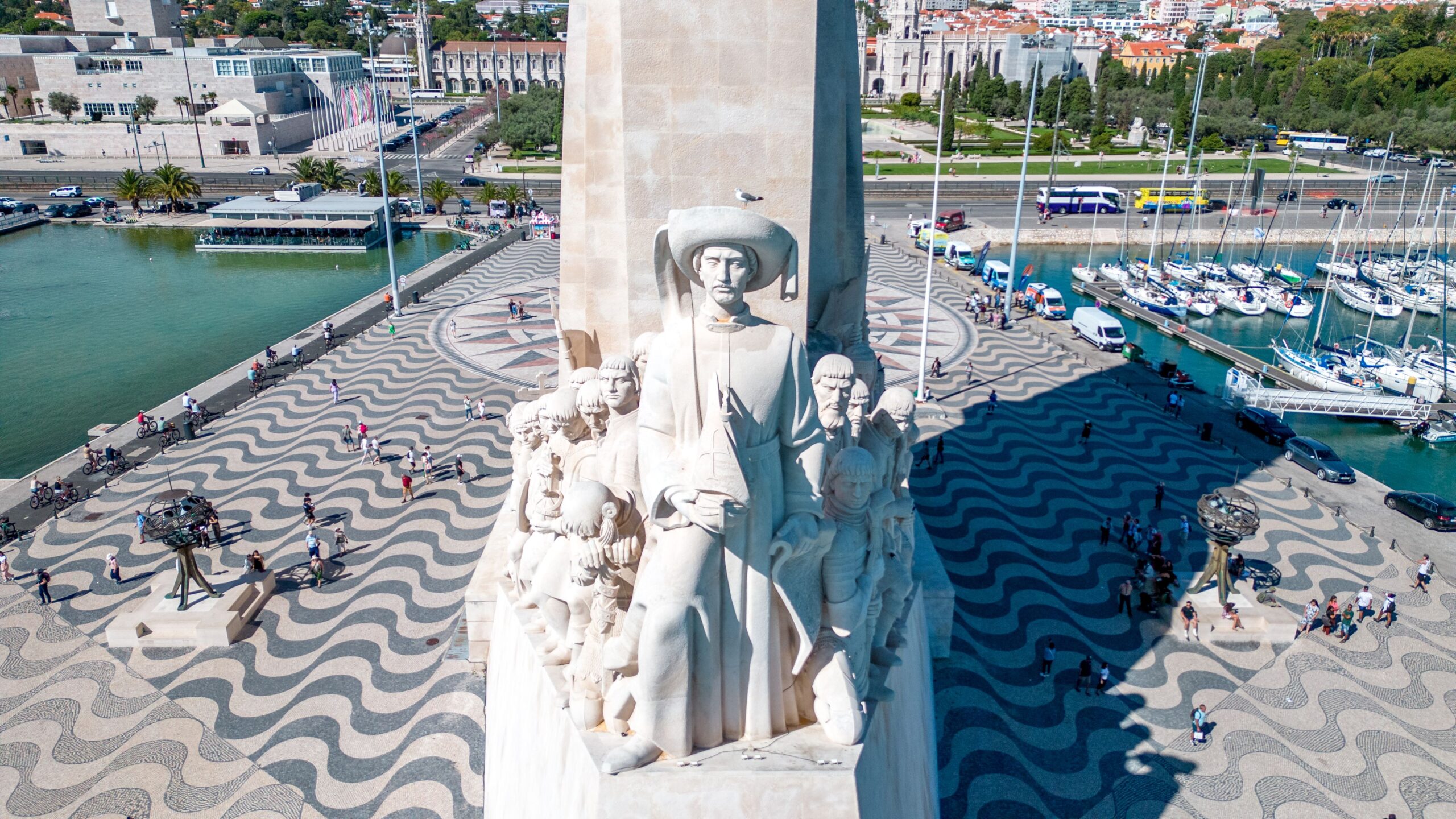
If you’re visiting Lisbon, you’ll find reminders of this incredible period everywhere—from the magnificent Belém Tower and Jerónimos Monastery to the famous Monument to the Discoveries overlooking the Tagus River where many expeditions departed.
In this guide, we’ll explore how it all began, who made it happen, why Portugal led the world, and how these voyages changed history forever.
👉 Want to understand the history behind Belém’s famous monuments? A guided Belém tour is one of the best ways to discover the stories of Portugal’s explorers, the monasteries, towers and waterfront that shaped world history. Check out the top-rated Belém experiences on Getyourguide here.

Understanding Portugal’s Age of Discoveries and Age of Exploration
1. Portugal Was Perfectly Positioned to Begin the Age of Exploration
The Age of Exploration didn’t happen by accident. Portugal possessed a unique combination of geography, politics and ambition that made it the ideal nation to lead Europe’s maritime expansion.
Unlike many European kingdoms that were constantly fighting their neighbours, Portugal enjoyed relatively stable borders after the 13th century. With the Reconquista largely complete, Portuguese rulers could focus their attention outward toward the Atlantic Ocean rather than defending land frontiers.
Its long Atlantic coastline was filled with excellent natural harbours, while cities like Lisbon and Porto became thriving centres of shipbuilding, navigation and trade.
Portugal also sat at the crossroads between northern Europe, the Mediterranean and Africa. Merchants regularly traded with England, Flanders, Italy and North Africa, exposing Portuguese sailors to new ideas, technologies and opportunities.
At the same time, European demand for spices, gold, silk and luxury goods from Asia continued to grow. Unfortunately, many traditional overland trade routes were controlled by powerful Muslim empires and Italian merchant cities such as Venice and Genoa.
Portuguese leaders realised that finding a direct sea route to Asia could make their kingdom unimaginably wealthy.
This ambition would spark over two centuries of exploration.
2. Prince Henry the Navigator Helped Launch Portugal’s Maritime Revolution
No individual is more closely associated with the beginning of Portugal’s explorations than Prince Henry the Navigator (Infante Dom Henrique).
Interestingly, Henry was not actually a great navigator himself. Instead, he acted as the visionary organiser, patron and financier behind many early expeditions.
Following Portugal’s capture of Ceuta in Morocco in 1415, Henry became fascinated by Africa and the possibilities lying beyond the known world.
He encouraged exploration further down Africa’s western coastline, sponsoring dozens of voyages that gradually pushed farther south than any European had sailed before.
Henry gathered together some of Europe’s finest:
- Cartographers
- Astronomers
- Shipbuilders
- Sailors
- Mathematicians
Although historians debate whether he founded a formal “navigation school” at Sagres, there is little doubt that southern Portugal became an important centre for nautical innovation under his patronage.
During his lifetime Portuguese sailors discovered or settled:
- Madeira
- The Azores
- Cape Verde
They also dramatically improved navigation techniques that would later make ocean crossings possible.
Henry died in 1460 before seeing the greatest successes of Portuguese exploration, but without his long-term investment, those achievements may never have happened.
3. Portugal Had Powerful Reasons for Exploring the Unknown
Exploration required enormous investment and carried tremendous risks. Ships disappeared without trace, storms destroyed fleets and many sailors never returned home.
So why did Portugal keep sending expeditions?
The answer lies in several powerful motivations working together.
Wealth
Perhaps the biggest motivation was money.
Europe desperately wanted:
- Pepper
- Cinnamon
- Cloves
- Nutmeg
- Silk
- Porcelain
- Precious stones
These goods travelled thousands of kilometres through numerous middlemen, making them extremely expensive.
Finding a direct sea route promised huge profits.
Gold
Portugal also sought West African gold, which was already flowing north across the Sahara Desert through Arab trading networks.
Religion
Many Portuguese rulers hoped to spread Christianity while also finding legendary Christian allies such as the mythical Prester John, who was believed to rule somewhere in Africa or Asia.
Prestige
European kingdoms competed fiercely for influence. Overseas discoveries increased national prestige and strengthened royal authority.
Curiosity
Finally, many sailors genuinely wanted to discover what lay beyond the horizon.
The combination of commerce, religion, science and adventure created an unstoppable drive to explore.
4. Portuguese Explorers Slowly Mapped the Coast of Africa
Rather than immediately crossing oceans, Portuguese exploration advanced gradually.
Each expedition travelled slightly farther than the previous one before returning home with new maps and knowledge.
This careful approach steadily revealed Africa’s western coastline.
Important milestones included:
- Cape Bojador
- Senegal
- Gambia
- Sierra Leone
- Gulf of Guinea
Portuguese sailors established trading relationships with many African kingdoms, exchanging textiles, metal goods and manufactured products for:
- Gold
- Ivory
- Pepper
- Slaves
Along the coast they built fortified trading posts known as feitorias, many of which became permanent settlements.
One of the most important was Elmina Castle in present-day Ghana.
These coastal networks laid the foundations for Portugal’s future global empire.
5. Bartolomeu Dias Proved That India Could Be Reached by Sea
For decades, many Europeans wondered whether Africa continued endlessly south.
In 1488, Bartolomeu Dias answered that question.
After battling violent storms, Dias unknowingly rounded the southern tip of Africa before turning north again into the Indian Ocean.
When he realised what had happened, he had proved something extraordinary.
Africa had an end.
India could potentially be reached entirely by sea.
Dias named the headland the Cape of Storms, but King João II renamed it the Cape of Good Hope, believing it represented hope of reaching Asia.
Although Dias was forced to return before reaching India, his voyage remains one of the greatest breakthroughs in exploration history.
6. Vasco da Gama Opened the Sea Route to India
If Bartolomeu Dias opened the door, Vasco da Gama walked through it.
In 1497, Da Gama left Lisbon with four ships.
After rounding the Cape of Good Hope, his expedition crossed the Indian Ocean with the assistance of experienced local pilots before finally arriving in Calicut (Kozhikode) on India’s southwest coast in 1498.
For the first time in history, Europe and India had been directly connected by sea.
The consequences were enormous.
Portugal quickly established trading posts throughout the Indian Ocean, eventually controlling major spice routes stretching from East Africa to India and Southeast Asia.
Although Da Gama’s relationships with local rulers were often difficult and sometimes violent, his voyage fundamentally changed global trade.
Lisbon rapidly became one of Europe’s richest cities as spices flowed into its markets.
👉 Want to follow in Vasco da Gama’s footsteps? Many visitors combine a visit to Jerónimos Monastery with a Belém sightseeing tour to understand the connection between Portugal’s explorers and Lisbon’s most famous landmarks. Find highly rated Belém and Jerónimos Monastery experiences on GetYourGuide here.
7. Portugal Built One of History’s First Truly Global Trading Empires
Following Vasco da Gama’s success, Portugal expanded astonishingly quickly.
Rather than conquering huge territories, the Portuguese often controlled strategic ports that allowed them to dominate maritime trade.
Their network eventually stretched across:
- Morocco
- West Africa
- Angola
- Mozambique
- India
- Sri Lanka
- Malaysia
- Indonesia
- China
- Japan
- Brazil
Important trading centres included Goa, Malacca, Hormuz and Macau.
Ships carried spices east to west while transporting silver, textiles, ceramics and countless other goods in the opposite direction.
For the first time, goods could travel around much of the world through interconnected maritime routes.
This early form of globalisation transformed international commerce forever.
8. Brazil Became Portugal’s Greatest Overseas Colony
In 1500, another major discovery changed Portugal’s future.
While leading a fleet toward India, Pedro Álvares Cabral sailed far into the Atlantic, eventually reaching what is now Brazil.
Whether this westward route was accidental or intentional remains debated by historians.
Cabral claimed the land for Portugal under the Treaty of Tordesillas, an agreement between Portugal and Spain dividing newly discovered territories outside Europe.
Initially, Brazil attracted limited attention.
However, its enormous natural resources soon became impossible to ignore.
Portugal developed:
- Sugar plantations
- Timber industries
- Gold mining
- Diamond mining
- Coffee production (later)
Over time, Brazil became Portugal’s largest and wealthiest colony.
Its influence remains obvious today.
Brazil is now the world’s largest Portuguese-speaking country, with over 200 million people sharing Portugal’s language and many cultural traditions.
9. Portuguese Explorers Reached China, Japan and the Far East
Many people mistakenly believe Portuguese exploration ended after reaching India.
In reality, some of the greatest achievements came afterwards.
Portuguese merchants pushed farther east across Asia.
They reached:
- Malacca (Malaysia)
- The Spice Islands (Indonesia)
- China
- Japan
In 1557 Portugal established Macau, which became Europe’s gateway to China for centuries.
Portuguese traders introduced European products into Asia while bringing tea, porcelain, silk and countless other goods back to Europe.
Japan encountered Europeans for the first time through Portuguese merchants arriving in 1543.
This exchange introduced firearms, Christianity and new trading opportunities that significantly influenced Japanese history.
10. Ferdinand Magellan Helped Complete the First Circumnavigation of the Earth
Although Ferdinand Magellan (Fernão de Magalhães) was Portuguese, he famously sailed under the Spanish flag after disagreements with Portugal’s king.
In 1519 he departed Spain searching for a western route to Asia.
His expedition crossed the Atlantic, discovered the strait that now bears his name and entered the vast Pacific Ocean.
Magellan himself was killed in the Philippines in 1521.
However, one surviving ship—the Victoria—continued westward and eventually returned to Spain in 1522.
This completed the first circumnavigation of the Earth, proving beyond doubt that the world’s oceans were connected.
It remains one of humanity’s greatest voyages.
11. Portuguese Innovation Changed Navigation Forever
Portugal’s success depended upon much more than brave sailors.
It also relied upon remarkable technological advances.
Portuguese shipbuilders perfected the caravel, a relatively small but highly manoeuvrable vessel capable of sailing against the wind.
Later, larger carracks enabled massive cargoes to travel between continents.
Navigators increasingly relied upon:
- Astrolabes
- Quadrants
- Improved maps
- Better compasses
- Celestial navigation
Cartographers constantly updated charts using information returned by explorers.
Each successful expedition made the next one safer.
These innovations would eventually benefit every maritime nation.
12. The Age of Discoveries Also Expanded the Transatlantic Slave Trade
While Portugal’s maritime achievements remain extraordinary, the Age of Discoveries also has a deeply painful legacy.
Portuguese traders became heavily involved in the Atlantic slave trade, transporting millions of enslaved Africans across the Atlantic over several centuries.
Initially, slavery formed only part of Portuguese trade along the African coast.
However, as sugar plantations expanded in places such as Brazil, demand for enslaved labour grew dramatically.
Families were separated, communities devastated and millions of people suffered unimaginable cruelty.
Today, historians recognise that Portugal’s Age of Discoveries cannot be understood honestly without acknowledging both its remarkable achievements and its devastating human consequences.
Modern Portugal openly discusses many aspects of this history through museums, education and public debate.
Understanding both sides provides a fuller picture of this complex period.
👉 Interested in learning more about this often-overlooked part of Lisbon’s history? Several excellent walking tours explore Portugal’s role in the Atlantic slave trade, colonialism and the experiences of African communities in Lisbon. Discover slavery history tours in Lisbon on Viator here.
13. Lisbon Became the Wealthiest Port in Europe
The discoveries transformed Lisbon itself.
Ships constantly arrived carrying spices, silk, gold, ivory, porcelain, exotic animals and precious stones from across the world.
Merchants speaking dozens of languages filled the city’s waterfront.
Foreign ambassadors marvelled at Lisbon’s wealth.
Magnificent churches, monasteries and palaces were funded by profits from overseas trade.
Many of Lisbon’s most famous landmarks date directly from this period, including:
- Jerónimos Monastery
- Belém Tower
- Parts of the historic Belém waterfront
Walking through Belém today offers visitors one of Europe’s finest surviving landscapes from the Age of Discoveries.
Many voyages to India, Africa and Brazil departed from the banks of the Tagus River nearby.
14. The Age of Exploration Changed the World Forever
Few historical periods have reshaped human civilisation as dramatically as Portugal’s Age of Discoveries.
Its consequences included:
- Permanent sea routes connecting Europe, Africa, Asia and the Americas
- The rise of global trade
- Exchange of foods, animals and technologies between continents
- Spread of Christianity across parts of Asia, Africa and South America
- Growth of European colonial empires
- Scientific advances in navigation and geography
- The tragic expansion of the Atlantic slave trade
Modern globalisation traces many of its origins back to these Portuguese voyages.
Even today, Portuguese remains an official language across multiple continents, reflecting the extraordinary reach of this small Atlantic nation.
15. You Can Still Experience Portugal’s Age of Discoveries in Lisbon Today
One of the best things about learning this history is that much of it can still be experienced during a visit to Lisbon.
The city’s Belém district is essentially an open-air museum dedicated to the Age of Discoveries.
Don’t miss:
- Monument to the Discoveries (Padrão dos Descobrimentos) featuring many of Portugal’s greatest explorers.
- Belém Tower, once guarding Lisbon’s harbour entrance.
- Jerónimos Monastery, where Vasco da Gama famously prayed before departing for India.
- Navy Museum, showcasing Portugal’s remarkable maritime history.
- MAAT for understanding how Portugal’s relationship with the river has evolved.
- Walking along the Tagus waterfront where countless expeditions began their journeys into the unknown.
👉 Planning to explore Belém with an expert guide? Browse the highest-rated walking tours on Viator and discover the stories behind Portugal’s greatest explorers.
👉 Prefer skip-the-line experiences and small-group tours? Check the latest Belém experiences on GetYourGuide, including monastery visits, river cruises and full-day Lisbon tours.
👉 Staying nearby? Compare the best hotels in Belém and central Lisbon on Booking.com so you’re within easy reach of these incredible historical landmarks.

Where to Stay in Lisbon to Explore Portugal’s Age of Discoveries
If you’re planning to dive into Portugal’s fascinating Age of Discoveries, choosing the right area to stay can make exploring the city’s maritime history much easier. Fortunately, many of Lisbon’s most important landmarks are within easy reach of one another, whether you prefer to stay right by the waterfront or in the heart of the historic centre.
Belém – The Best Choice for History Lovers
If the Age of Discoveries is the main reason for your visit, Belém is the obvious choice. This peaceful riverside district is home to many of Portugal’s most iconic historical sites, including Belém Tower, Jerónimos Monastery, the Monument to the Discoveries, the Navy Museum, and the beautiful waterfront where many famous expeditions once began. Staying here allows you to explore these landmarks early in the morning or later in the evening, after most day-trippers have left.
👉 Looking for the perfect base? Browse the best hotels in Belém on Booking.com and stay just steps from Portugal’s greatest Age of Discoveries landmarks.
Baixa & Chiado – Best for First-Time Visitors
If you’d like to combine history with sightseeing, shopping and great restaurants, Baixa and Chiado are excellent options. These central neighbourhoods are only a short tram, bus or taxi ride from Belém, while also placing you within walking distance of many of Lisbon’s other historic attractions, museums and viewpoints. They’re ideal if you want to balance Portugal’s maritime history with the city’s lively atmosphere.
My Recommendation
Having lived in Lisbon for years and spent plenty of time showing visitors around the city, I’d recommend staying in Baixa or Chiado if it’s your first visit, as you’ll have easy access to almost everything Lisbon has to offer. However, if you’re particularly interested in Portugal’s explorers, maritime history and the Age of Discoveries, spending a few nights in Belém offers a completely different experience. Walking along the Tagus at sunset, surrounded by the monuments that celebrate—and commemorate—this extraordinary period of history, is something I never get tired of recommending.
❓FAQs
❓When did Portugal’s Age of Discoveries begin?
Most historians date the beginning of the Portuguese Age of Discoveries to 1415, when Portugal captured Ceuta in North Africa. This event marked the start of sustained overseas expansion and was followed by decades of exploration along the African coast under the patronage of Prince Henry the Navigator.
❓Why did Portugal begin exploring?
Portugal was motivated by several factors, including the search for direct trade routes to Asia, access to gold and spices, the desire to spread Christianity, increased national prestige and growing curiosity about the wider world.
❓Who was Prince Henry the Navigator?
Prince Henry the Navigator was a Portuguese royal who sponsored many of the early voyages of exploration. Although he rarely sailed himself, his financial support and encouragement helped lay the foundations for Portugal’s maritime success.
❓Who discovered the sea route to India?
Vasco da Gama became the first European to reach India by sea in 1498, sailing around the Cape of Good Hope and across the Indian Ocean to Calicut.
❓Who discovered Brazil?
Brazil was claimed for Portugal by Pedro Álvares Cabral in 1500 during an expedition that was originally heading for India.
❓Did Ferdinand Magellan sail for Portugal?
Magellan was Portuguese by birth but undertook his famous circumnavigation expedition under the Spanish crown after failing to gain Portuguese support for his plans.
❓Why is the Age of Discoveries controversial today?
While it brought remarkable advances in navigation, science and global trade, the Age of Discoveries also led to colonisation, violence and the expansion of the Atlantic slave trade. Modern historians study both its achievements and its lasting human consequences.
❓Where can I learn more about the Age of Discoveries in Lisbon?
The best places to visit include the Monument to the Discoveries, Belém Tower, Jerónimos Monastery, the Navy Museum, and the waterfront in Belém, where many famous expeditions began.
👉 If you want to discover how Portugal’s exploration era shaped modern Lisbon, a local history walking tour is a fantastic way to connect the city’s streets, monuments and stories. Explore Lisbon’s best historical tours on GetYourGuide here.
Final Thoughts
Portugal’s Age of Discoveries was one of the most influential periods in world history. Driven by ambition, curiosity, commerce and faith, Portuguese explorers opened sea routes that connected continents, transformed global trade and forever changed how people understood the world.
Figures such as Prince Henry the Navigator, Bartolomeu Dias, Vasco da Gama, Pedro Álvares Cabral and Ferdinand Magellan became household names because their voyages pushed beyond the limits of the known world. Their achievements helped make Lisbon one of the richest cities in Europe and established Portugal as the first truly global maritime empire.
At the same time, this era also reminds us that exploration came with profound human costs. Colonisation, conquest and the Atlantic slave trade left lasting scars whose effects are still felt today. Understanding both the remarkable achievements and the darker consequences gives a more complete picture of this pivotal chapter in history.
Whether you’re strolling through Belém, admiring the Monument to the Discoveries or standing on the banks of the Tagus where fleets once sailed into the unknown, it’s impossible not to appreciate how deeply this extraordinary period shaped Lisbon, Portugal and the wider world.
Whenever I take friends or visitors to Belém, I always encourage them to look beyond the impressive architecture. The river, the monuments and the monasteries aren’t just beautiful sights—they’re reminders of a period that changed the course of world history. Portugal’s Age of Discoveries was an incredible achievement in navigation and exploration, but it’s also a story with complex consequences that deserve to be understood. I hope this guide has helped bring that history to life and, if you’re visiting Lisbon, I think you’ll appreciate the city even more after seeing these places with the full story in mind.
About the author
I’m Duncan, a Lisbon-based guide and writer who’s lived here for 11 years and taken hundreds of visitors around the city. I created Lisbon Listicles to share everything you need to know about Lisbon in clear, practical lists — from iconic sights to hidden gems — so you can plan your trip easily and make the most of your time here.
All recommendations are based on personal experience and the questions I hear most often from visitors.
Leave a Reply