Disclosure: Some links in this article are affiliate links. If you book through them, I may earn a small commission at no extra cost to you. I only recommend places and experiences I genuinely think are worth it.
Long before Lisbon became the city we know today, it was known as Al‑Ushbuna — a thriving port under Moorish rule with its own culture, architecture, and rhythm of life. When you start digging into Lisbon’s deeper history, this chapter is one of the most fascinating, yet it’s surprisingly easy to overlook while wandering the modern city.
Living here, I’ve always been intrigued by the layers of Lisbon’s past. The Moorish period in particular adds an entirely different perspective — one that you can still glimpse today in street layouts, archaeological finds, and fragments of the old city that survived centuries of change. Through local museums, historical research, and exploring neighborhoods like Alfama where traces still linger, I’ve come to appreciate just how much Al-Ushbuna shaped the Lisbon we see today.
This guide explores nine snapshots from that period — moments that help bring Moorish Lisbon back to life.
Al-Ushbuna
Before Lisbon became Europe’s sun-kissed capital of fado and tiled façades, it was known as Al-Ushbuna (or Al-Uxbuna) — a thriving Moorish city that pulsed with trade, scholarship, and art. For over four centuries, Lisbon belonged to al-Andalus, the vast Muslim-ruled region that stretched across the Iberian Peninsula.
This was a city of minarets, bazaars, and fortified walls, where Arabic echoed down stone alleys and gardens bloomed with fountains and citrus trees. Today, fragments of that world still linger in Lisbon’s Alfama, Castelo de São Jorge, and even its cuisine.
Here are 9 fascinating snapshots that reveal what Lisbon was like under Moorish rule — and how to explore it today.

Lisbon Under Moorish Rule: 9 Fascinating Snapshots of Al-Ushbuna
🏰 1. The Birth of Al-Ushbuna
When the Moors crossed the Strait of Gibraltar in 711 CE, they brought new technologies, sciences, and architectural ideas.
Within a few decades, Lisbon — once Roman Olissipo — was transformed into Al-Ushbuna, a bustling port city in al-Andalus.
Arabic became the language of commerce and learning, while the city grew wealthy from silk, spices, and ceramics traded through its harbor.
The Moors introduced advanced irrigation, public baths, and urban planning that shaped Lisbon’s medieval heart.
🏡 2. Urban Design: A City of Shade and Wind
The Alfama district’s twisting streets are a living Moorish design. They were engineered to maximize shade, funnel cool breezes, and protect against invaders.
The name “Alfama” derives from the Arabic “Al-Hammam”, meaning baths, a nod to the natural hot springs that fed public bathhouses.
Homes were built inward-facing, around courtyards and fountains, reflecting the Islamic vision of the home as a private oasis.
These designs weren’t just practical — they were spiritual, echoing the Qur’anic image of paradise as a garden of flowing water.
🧱 3. Fortifications: The Walls of Al-Ushbuna
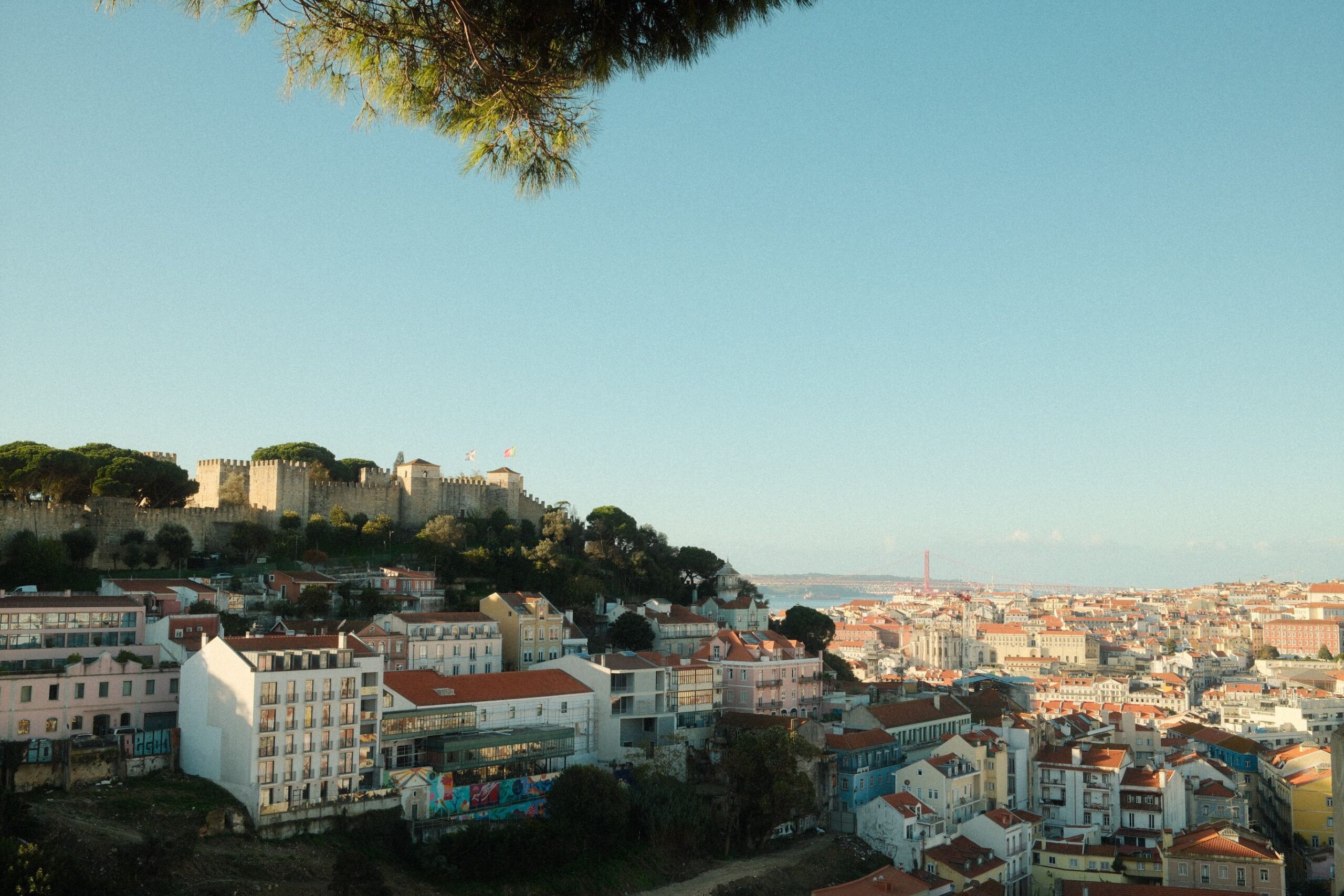
The Moors fortified Lisbon with massive walls enclosing the hilltop citadel that would later become Castelo de São Jorge.
Archaeologists have uncovered segments of these Moorish walls, still visible beneath later medieval masonry.
These walls defended the city during the Siege of Lisbon (1147) — one of the bloodiest episodes of the Christian Reconquest.
You can still trace their line through the streets around Rua do Chão da Feira and Costa do Castelo.
👉 Walk through the ancient ramparts on a Moorish Walls & Castle Tour via Viator.
🕌 4. Daily Life in the Moorish City
Life in Al-Ushbuna revolved around faith, family, and trade. The call to prayer from minarets marked the city’s rhythm.
Markets (souks) sold everything from olive oil to perfume, while hammams (public baths) were places of both cleanliness and community.
Christians and Jews lived under Muslim rule as dhimmi — protected peoples — contributing to a vibrant, multi-faith society.
Scholars and scientists thrived here, bringing astronomy, mathematics, and medicine from Córdoba and Seville.
Beneath Casa dos Bicos, excavations reveal fragments of Moorish houses — a literal window into 11th-century Lisbon life.
👉 Experience this heritage firsthand with an Islamic Lisbon & Hidden History Tour on GetYourGuide.
🏛️ 5. Architecture & the Moorish Eye for Beauty
Moorish architecture prized symmetry, geometry, and light — principles that later inspired Portugal’s signature azulejos.
The horseshoe arch, intricate stucco work, and serene courtyards reflect a fusion of Andalusian and Maghrebi artistry.
The Palácio Belmonte, one of Lisbon’s oldest palaces, rests on Moorish and Roman foundations.
The Sé Cathedral stands where a mosque once rose, reusing much of its original stonework.
Even modern Lisbon’s tiles and lattice balconies echo this timeless aesthetic.
🌳 6. Gardens of Water and Light
The Moors saw gardens as reflections of paradise — spaces of peace, order, and sensual beauty.
Lisbon’s early gardens were designed around water channels, orange trees, and shaded pavilions.
Though few survive, traces remain in the city’s Estufa Fria, Jardim do Torel, and courtyard fountains in Mouraria.
The soothing sound of water and scent of citrus still carry echoes of Islamic garden design.
👉 Wander Lisbon’s hidden green havens with a Gardens Tour through GetYourGuide.
⚔️ 7. The Siege of Lisbon: Fall of Al-Ushbuna
In 1147, Christian forces led by King Afonso I and northern crusaders laid siege to Lisbon.
After months of starvation and combat, the city fell, ending over 400 years of Muslim rule.
Many Moors remained as artisans or farmers, contributing to Lisbon’s transformation into a Christian capital.
Yet the city layout, well systems, and fortifications all retained Moorish origins.
🧭 8. Rediscovering Al-Ushbuna Today
Lisbon’s Museum of Lisbon and local archaeologists continue to unearth Islamic artifacts — pottery, tools, and inscriptions.
The Islamic Lisbon Walking Tour traces these hidden remains through Alfama and Baixa.
You’ll see how Moorish culture quietly shaped everything from Lisbon’s architecture to its street names.
As the city embraces its multicultural roots, these Moorish stories are being revived in art, scholarship, and tourism.
👉 Step back in time with an immersive Lisbon Islamic Heritage Tour on GetYourGuide.
🍊 9. A Taste of Al-Ushbuna
The Moors brought with them citrus fruits, almonds, rice, and sugarcane, transforming Portuguese cuisine.
Desserts like arroz doce (sweet rice pudding), açorda, and amêndoas doces trace their lineage to Moorish recipes.
Lisbon’s markets and bakeries still whisper of that culinary past through spices like cinnamon, saffron, and cloves.
Taking a food tour is the best way to taste this layered heritage.
👉 Indulge your senses on a Lisbon Food & History Tour via Viator.

🌙 Final Thoughts: Lisbon’s Layered Soul
Lisbon is a city written in layers — Roman, Moorish, and Christian — each one adding depth and color to its story. The Moors gave Lisbon its first true urban plan, its defensive walls, its sophisticated irrigation, and a sense of beauty rooted in geometry and balance.
When you wander the Alfama’s labyrinthine alleys, listen to fado, or watch the sun set over the Tagus, remember: you’re standing on the stones of Al-Ushbuna, where the Middle East once met the Atlantic.
For me, understanding Lisbon’s Moorish past changes the way I see the city. Streets that seem purely Portuguese suddenly feel older and more complex, carrying influences from cultures that shaped Lisbon long before the modern era.
If this guide does anything, I hope it encourages you to look at Lisbon with a slightly different lens — one where the story stretches far deeper than the buildings we see today. In many ways, the spirit of Al-Ushbuna still quietly echoes through the city. 🏛️
Lisbon’s Moorish past isn’t just history — it’s the quiet heartbeat beneath the modern city.
About the author
I’m Duncan, a Lisbon-based guide and writer who’s lived here for 11 years and taken hundreds of visitors around the city. I created Lisbon Listicles to share everything you need to know about Lisbon in clear, practical lists — from iconic sights to hidden gems — so you can plan your trip easily and make the most of your time here.
All recommendations are based on personal experience and the questions I hear most often from visitors.
Leave a Reply