Disclosure: Some links in this article are affiliate links. If you book through them, I may earn a small commission at no extra cost to you. I only recommend places and experiences I genuinely think are worth it.
If you’ve spent any time researching Lisbon before your trip, there’s a good chance you’ve already seen Pink Street.
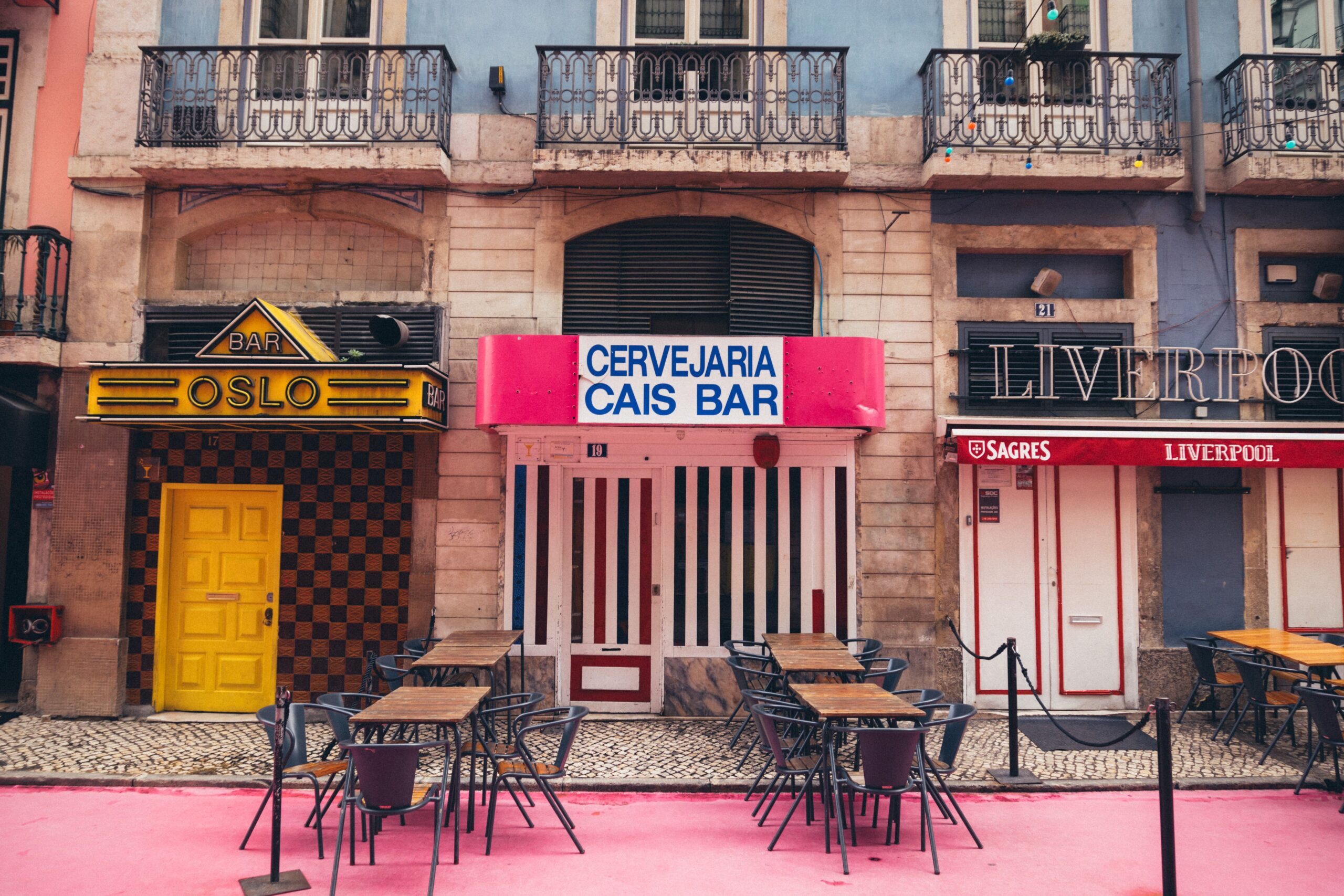
That bright pink strip of pavement, usually photographed beneath a canopy of colourful umbrellas, has become one of the most recognisable images of modern Lisbon. It’s colourful, slightly ridiculous, very photogenic and, depending on what time you visit, either strangely quiet or absolutely packed with people.
But there’s considerably more to Pink Street than taking a photograph and moving on.
Officially called Rua Nova do Carvalho, Pink Street sits in Cais do Sodré, one of Lisbon’s most interesting neighbourhoods. The street is only a couple of hundred metres long, but it has a surprisingly colourful history involving sailors, bars, prostitution, music, nightlife and the dramatic transformation of Lisbon’s waterfront.
Today, it’s one of the city’s best-known nightlife spots, with bars and clubs packed into and around the street. It’s also within easy walking distance of the Tagus waterfront, Mercado da Ribeira, Chiado, Bairro Alto and Praça do Comércio.
I’ve lived in Lisbon for several years and worked as a tour guide, and Pink Street is somewhere I tend to give visitors slightly different advice about than the standard travel guides.
Yes, you should see it.
But no, you probably don’t need to spend half your evening standing on a pink road taking photographs.
The trick is knowing when to go, what to see, where to drink and how to use Pink Street as part of a wider visit to Cais do Sodré.
So, whether you’re visiting for the famous photograph, looking for Lisbon nightlife, interested in the history of the old red-light district or simply wondering whether Pink Street is actually worth your time, here’s everything you need to know.
👉 For more cool spots for nightlife in Lisbon, read my full post.
A Quick Introduction to Pink Street
Pink Street is the popular name for Rua Nova do Carvalho, a pedestrianised street in the Cais do Sodré area of central Lisbon.
It’s tucked just behind the waterfront and Cais do Sodré station, making it extremely easy to reach.
The street itself is free to visit. There is no ticket, entrance fee or attraction building. It’s simply a public street lined with bars, restaurants and nightlife venues.
During the day, it can be surprisingly quiet.
At night, particularly towards the weekend, it becomes a very different place.
The pink pavement is obviously the star of the show, but what makes the street interesting to me is the contrast between its current appearance and its past.
This was once part of Lisbon’s notorious nightlife and red-light district, particularly associated with sailors and the port. Today, it’s one of the most photographed and tourist-friendly nightlife streets in the city.
That transformation is worth understanding before you visit.
The History of Pink Street Lisbon
From sailors and port workers to Lisbon’s red-light district
Cais do Sodré has long been connected with Lisbon’s river and port.
Its location beside the Tagus made it a natural meeting point for sailors, port workers, travellers and merchants, and the nightlife that developed here reflected that working waterfront.
Rua Nova do Carvalho became particularly associated with sailors and the establishments that catered to them.
Bars and clubs developed along the street, and the area acquired a much seedier reputation than the colourful tourist destination you see today.
Lisbon’s municipal publication describes the old Rua Nova do Carvalho as a street frequented by sailors and prostitutes, with bars and nightclubs associated with more marginal activities.
In other words, the street really did have a red-light-district past.
This isn’t simply a story invented later to make Pink Street sound more interesting.
The old nightlife survives in the names
Some of the area’s history can still be traced through the names of its nightlife venues.
Places such as Jamaica, Europa, Tâmisa and Texas Bar became associated with Cais do Sodré’s nightlife during the twentieth century. Some of those names or premises subsequently evolved into newer venues.
The result was a nightlife district with a very particular character.
It wasn’t traditionally polished or sophisticated.
It was rougher, louder and more closely connected with the working waterfront.
During the 1980s, younger people also began discovering the area’s less respectable side, while new bars and restaurants gradually appeared alongside the older establishments.
That eventually helped create the conditions for the much bigger transformation that came in the 2010s.
The transformation of Rua Nova do Carvalho
The modern story of Pink Street really begins around 2011.
Local businesses and the Associação do Cais do Sodré pushed for the street to be transformed into a pedestrian-friendly public space with outdoor terraces.
Rua Nova do Carvalho was pedestrianised, and in December 2011 the road was famously painted pink. The painting was carried out by the street-art duo Artbuilding, with support from Lisbon City Council.
The colour was intended to make a statement.
It was an inexpensive but remarkably effective way of signalling that this was no longer going to be quite the same Cais do Sodré.
The architect José Adrião, whose studio was involved in the later public-space project, describes the pink paint as a pragmatic gesture that announced a change in the area.
There is a small wrinkle in the timeline worth knowing.
The initial pink painting happened in 2011, while the broader architectural project was developed in 2012 and constructed in 2013. Later interventions included levelling the pavement and roadway and creating a more flexible pedestrian public space.
So if you see different dates quoted for the birth of Pink Street, that’s why.
The transformation wasn’t one single event.
It was a process.
From local nightlife spot to international attraction
And it worked.
The distinctive pink road made Rua Nova do Carvalho instantly recognisable.
Photos began appearing online, the street developed its nickname of Pink Street, and visitors started coming specifically to see it.
The city’s own tourism website now describes Rua Cor-de-Rosa as a place where popular nightclubs mix with the old sailors’ bars, creating a combination of different atmospheres and musical styles.
That is probably the best way to understand Pink Street today.
It isn’t an ancient Lisbon attraction.
It’s a relatively recent piece of urban regeneration sitting on top of a much older nightlife culture.
And that makes it much more interesting than the pink paint alone suggests.

10 Things to Know Before Visiting Pink Street Lisbon
1. Visit Pink Street in the morning if you want the classic photograph
If your main reason for visiting Pink Street is the photograph, go early.
This is probably my number-one tip.
During the morning, Rua Nova do Carvalho can be remarkably quiet. The bars are generally closed or only just beginning to prepare for the day, and you have much more room to appreciate the street.
More importantly, you can actually take photographs.
Later in the day, people start wandering through, and by night the street becomes a nightlife destination rather than a photo opportunity.
You don’t necessarily need to arrive at sunrise, either.
Any reasonably early morning should give you a considerably quieter experience than Friday or Saturday night.
I particularly like the contrast between the empty pink street and the knowledge of what it will look like several hours later.
It’s hard to believe you’re looking at the same place.
My tip
Don’t just photograph the middle of the street.
Walk from one end to the other and take photographs in both directions.
Look upwards at the umbrellas and buildings as well as down at the pavement.
And don’t spend too long trying to recreate somebody else’s Instagram photograph.
The street itself is small enough that you can see it properly in a few minutes.
2. Come back at night to experience the real Pink Street
The daytime Pink Street is essentially a colourful urban photo opportunity.
The nighttime Pink Street is something else entirely.
As evening progresses, the bars open and people begin arriving for drinks and nightlife.
By late evening, particularly towards Thursday, Friday and Saturday, the atmosphere can become considerably louder and busier.
This is when you really understand why Cais do Sodré developed such a reputation for nightlife.
There is music coming from different venues, groups moving between bars and plenty of people simply standing outside talking and drinking.
If you’re expecting a peaceful historic street after dark, you’ll probably be disappointed.
If you’re looking for nightlife, you’ll probably be pleased.
The important thing is to choose your timing according to what you actually want.
Photography: morning.
A relaxed drink: early evening.
Nightlife: later in the evening.
The busiest atmosphere: late night at the weekend.
Personally, I wouldn’t arrive at 7pm and immediately decide that Pink Street is dead.
Lisbon nightlife starts late.
Give the area time.
3. Visit Pensão Amor for one of the most interesting pieces of Pink Street’s history
If you only choose one venue on Pink Street, I’d make it Pensão Amor.
This is not simply another bar.
The building’s history is tied directly to the old nightlife and red-light character of Cais do Sodré, and the interior deliberately plays with that past.
Inside, you’ll find theatrical décor, velvet, dark colours and an atmosphere that feels considerably more elaborate than the average bar on a nightlife strip.
It’s exactly the sort of place that helps explain why the history of Pink Street matters.
The modern version of Pensão Amor emerged during the same period that Cais do Sodré was being transformed, and academic research into the neighbourhood’s nightlife specifically identifies the reopening of Pensão Amor and the pedestrianisation and rebranding of Rua Nova do Carvalho as important parts of the area’s transformation.
You don’t have to be a serious nightlife person to appreciate it.
Go for a drink, have a look around and take in the décor.
Who is Pensão Amor best for?
Best for: couples, first-time visitors, people interested in Lisbon’s nightlife history and anyone wanting something more atmospheric than a generic bar.
Less suitable for: anyone looking for a quiet, inexpensive local café.
4. Explore the other bars rather than assuming Pink Street is one big nightclub
One mistake I see visitors make is treating Pink Street as if it were a single nightlife venue.
It isn’t.
There are several different bars and venues along Rua Nova do Carvalho and the surrounding streets, and they can offer very different experiences.
For example, Pink Wine Point is a straightforward choice if you’re looking for wine and drinks directly on the street.
Bookstore Bar Girl and Lass has a more unusual concept and is worth considering earlier in the evening.
And Noitada Bar & Tapas is another option if you’re looking for somewhere that combines drinks and food and stays open very late.
There are also plenty of other venues in the immediate area, so don’t feel that you have to choose somewhere simply because it has the biggest queue.
My advice
Walk the street first.
Have a look at what is happening.
Then decide.
Pink Street is compact enough that you can easily change your mind.
5. Check out Musicbox if you want live music or clubbing
For a more serious nightlife experience, look at Musicbox.
Musicbox is particularly interesting because it connects with the area’s older nightlife history: the venue occupies the former Texas Bar premises and became part of the modern Cais do Sodré music scene.
This is somewhere I’d choose if you actually want to go out, rather than simply have a drink on a photogenic street.
The programme varies, so check what’s happening on the night you visit.
You might find live music, DJs or another event rather than a standard bar night.
That variety is one of the strengths of Cais do Sodré.
6. Don’t spend your entire night on Pink Street
This is probably the most important piece of advice in the whole article.
Pink Street is tiny.
You can walk its entire length in a couple of minutes.
So while it is absolutely worth seeing, I wouldn’t plan an entire Lisbon evening around staying on this one street.
Instead, use Pink Street as the centre of a wider Cais do Sodré night out.
Start with dinner somewhere nearby.
Walk along the river.
Stop at Pink Street for photographs and a drink.
Then explore the surrounding streets.
If you want more nightlife, head towards Bairro Alto.
If you want something quieter, walk towards Chiado.
If you want the river, head down to Ribeira das Naus.
This gives you a much better evening than standing in the same 200 metres for four hours.
7. Combine Pink Street with the waterfront
One of the reasons I like this part of Lisbon is the contrast.
You can be surrounded by nightlife one minute and standing beside the Tagus a few minutes later.
From Pink Street, head towards the river and explore Ribeira das Naus.
It’s particularly pleasant around sunset, when you can sit beside the water and watch Lisbon’s waterfront change colour.
You can then continue towards Praça do Comércio if you want a longer walk.
This also gives you an excellent way to break up a night out.
Have dinner.
Walk beside the river.
Visit Pink Street.
Have a drink.
Then decide what you want to do next.
You get much more of Lisbon that way.
8. Walk up to Chiado or Bairro Alto
Pink Street’s location is another reason it makes a good stop rather than a destination in isolation.
You’re close to two of central Lisbon’s other major neighbourhoods.
Head uphill and you’ll reach Chiado, with its shops, cafés, theatres and historic streets.
Continue farther uphill and you’ll reach Bairro Alto, Lisbon’s traditional nightlife district.
This makes it possible to create a very easy walking route:
Cais do Sodré → Pink Street → Chiado → Bairro Alto
Or do it in reverse.
I’d actually recommend walking between the neighbourhoods rather than relying on taxis.
Lisbon’s centre is compact, and this is one of the best areas of the city to experience on foot.
Just remember that the hills are real.
Comfortable shoes are considerably more useful than fashionable ones.
9. Keep your belongings secure when Pink Street gets crowded
Pink Street is not somewhere I’d tell visitors to avoid because of safety.
It’s a busy central neighbourhood, surrounded by restaurants, transport connections, hotels and nightlife.
But the usual rules for a crowded nightlife district apply.
The biggest practical concern for tourists is petty theft, particularly when crowds become dense.
Keep your phone somewhere secure.
Don’t leave your wallet in an open back pocket.
Keep bags closed and in front of you in very crowded areas.
And don’t leave your phone sitting unattended on a table while you’re drinking.
None of this is unique to Pink Street.
It’s simply sensible city behaviour.
The important thing is not to become paranoid.
Enjoy yourself.
Just don’t switch your brain off because you’re on holiday.
Is Pink Street safe at night?
Generally, yes, provided you use normal precautions.
The atmosphere can become rowdy late at night, and people have obviously been drinking, so I’d use the same common sense you would in any busy European nightlife district.
If you’re travelling alone, stay aware of your surroundings and have a sensible plan for getting back to your accommodation.
10. Remember that Pink Street is touristy — and that’s okay
I’m deliberately putting this in the list because I think it’s something travel guides often avoid saying.
Pink Street is touristy.
There.
It is.
It’s one of Lisbon’s most photographed streets, it appears in countless travel guides and Instagram posts, and a significant proportion of the people taking photographs there are visitors.
That doesn’t mean it’s worthless.
It simply means you should have realistic expectations.
If you’re looking for a completely untouched, traditional Lisbon neighbourhood, this isn’t it.
But if you’re interested in the evolution of Lisbon’s nightlife, the regeneration of Cais do Sodré and a fun evening in the city centre, it’s still worth visiting.
And the wider neighbourhood has a genuine history that predates the tourism boom by many decades.
That’s the distinction I’d make.
Pink Street itself is touristy. Cais do Sodré is much more complicated and interesting.

Hotels Near Pink Street Lisbon
Staying near Pink Street can be an excellent idea if nightlife is one of your priorities.
Cais do Sodré is extremely well connected, and you can walk to Chiado, Baixa, Bairro Alto and the waterfront.
But there is one important warning:
If you stay directly beside Pink Street, you should expect noise.
This is not the location I’d choose if your priority is absolute peace and quiet.
Instead, I’d look at the wider Cais do Sodré, Chiado and Baixa areas.
Here are some options worth considering.
Best for a higher-end stay: Corpo Santo Lisbon Historical Hotel
Corpo Santo Lisbon Historical Hotel is one of the stronger options if you want to stay close to Pink Street without sleeping directly on the nightlife strip.
Its location puts you within easy walking distance of Cais do Sodré and the waterfront while still giving you a more refined hotel experience.
I’d particularly consider it for couples and travellers who want to be central but don’t necessarily want a party atmosphere outside their door.
Best for location: LX Boutique Hotel
LX Boutique Hotel is on Rua do Alecrim, between Cais do Sodré and Chiado.
That makes it an excellent base if you want to explore several central neighbourhoods on foot.
You can walk down to Pink Street, head uphill to Chiado or continue towards Bairro Alto without needing public transport.
For a first Lisbon visit, that flexibility is extremely useful.
Best if you want Baixa as your base
If Pink Street is only one part of your Lisbon trip, you don’t necessarily need to stay in Cais do Sodré itself.
Staying around Baixa gives you a slightly different atmosphere while keeping Pink Street within walking distance.
One option worth considering is Brown’s Downtown Hotel.
The advantage is that you can enjoy the nightlife around Cais do Sodré and then walk back towards Baixa when you’re ready for bed.
My hotel advice
When searching for accommodation, don’t restrict yourself to hotels described as being “on Pink Street”.
Instead, search across:
- Cais do Sodré
- Chiado
- Baixa
- Rua do Alecrim
- Praça Luís de Camões
- Corpo Santo
That gives you far more choice and, importantly, lets you decide how close you actually want to be to the nightlife.
👉 Looking for somewhere to stay near Pink Street? Compare current prices and availability on Booking.com before booking. Prices in Lisbon can vary dramatically depending on the dates.
Tours Around Pink Street and Cais do Sodré
You don’t need a tour to visit Pink Street.
It’s completely free and extremely easy to find.
However, a tour can make sense if you’re interested in the history behind the neighbourhood, rather than simply taking a photograph.
A good Lisbon walking tour can put Pink Street into context by connecting it with Cais do Sodré, the waterfront, Baixa, Chiado and the city’s maritime history.
Food tours can also work particularly well in this part of town because you’re close to a huge range of restaurants, markets and traditional eating spots.
👉 Want to explore Lisbon with a local guide? Take a look at the latest Viator tours in Lisbon, including walking, food and sightseeing experiences.
You can also browse GetYourGuide Lisbon tours for small-group walks and other experiences around the historic centre.
If Pink Street is your main interest, however, I wouldn’t book a tour solely to see it.
Spend your money on a tour that teaches you something about Lisbon as a whole.
Pink Street itself is very easy to explore independently.
Practical Tips for Visiting Pink Street
A few final things can make the experience considerably easier.
Go early for photographs
If you want the classic Pink Street photograph without crowds, morning is your friend.
Go late for nightlife
If you’re expecting the famous party atmosphere, don’t arrive at 6pm and assume nothing is happening.
Lisbon nightlife starts late.
Don’t expect every bar to be sophisticated
Some places are simply straightforward nightlife bars.
That’s part of the experience.
Wear comfortable shoes
You’ll probably walk much farther than Pink Street itself.
Don’t forget the river
The Tagus is only a few minutes away and is one of the best parts of the neighbourhood.
Be careful with your phone
Especially once the crowds build.
Don’t feel obliged to stay
If Pink Street isn’t your scene, walk away.
Cais do Sodré, Chiado and Bairro Alto are all nearby.
Check individual venue hours
Pink Street itself has no closing time because it’s a public street, but individual businesses have their own schedules, which can change.
Don’t confuse a good photograph with a good evening
This is perhaps the most important tip.
Take the photograph.
Then go and explore Lisbon.
❓Frequently Asked Questions About Pink Street Lisbon
❓What is Pink Street in Lisbon?
Pink Street is the nickname for Rua Nova do Carvalho, a short pedestrianised street in Cais do Sodré known for its bright pink pavement, colourful umbrellas, bars and nightlife.
❓Why is Pink Street pink?
The street was painted pink as part of the regeneration of Cais do Sodré. The initial painting took place in December 2011, helping establish the street’s new identity.
❓What is the real name of Pink Street?
Its official name is Rua Nova do Carvalho.
The name Pink Street, or Rua Cor-de-Rosa in Portuguese, became popular after the road was painted pink.
❓What is the history of Pink Street?
Rua Nova do Carvalho was historically part of the nightlife and red-light district around Cais do Sodré and was particularly associated with sailors, prostitutes, bars and clubs.
Its transformation into modern Pink Street began in the early 2010s, when the road was pedestrianised and painted pink as part of the regeneration of the area.
❓Is Pink Street worth visiting?
Yes, particularly if you’re already exploring Cais do Sodré.
I’d recommend visiting for the photograph and then exploring the surrounding neighbourhood rather than travelling across Lisbon solely to see the pink pavement.
❓What is the best time to visit Pink Street?
Go in the morning if you want photographs.
Visit in the evening if you want the bars.
For the liveliest nightlife, visit later at night, particularly towards the weekend.
❓Is Pink Street free?
Yes.
It’s a public street, so there is no admission fee.
You’ll only pay for anything you choose to buy in the bars, restaurants or other businesses.
❓Is Pink Street safe?
Generally, yes.
It’s a busy central nightlife area, but you should take normal precautions against pickpocketing and other petty theft, particularly when the street becomes crowded.
❓Is Pink Street safe for solo travellers?
Yes, although I’d use sensible nightlife precautions.
Keep your belongings secure, avoid becoming excessively intoxicated and have a plan for getting back to your accommodation.
❓Is Pink Street suitable for children?
During the daytime, yes.
Late at night, I’d choose somewhere else for a family outing because the area becomes a busy adult nightlife district.
❓What are the best bars on Pink Street?
Pensão Amor is one of the most distinctive and historically interesting options.
Pink Wine Point is another straightforward choice directly on the street, while Bookstore Bar Girl and Lass offers a more unusual atmosphere.
For live music and clubbing, check what’s happening at Musicbox.
❓Is Pink Street near Bairro Alto?
Yes.
Bairro Alto is within easy walking distance, although you’ll need to walk uphill from Cais do Sodré.
❓Is Pink Street near Time Out Market?
Yes.
Time Out Market is only a short walk away in the wider Cais do Sodré area.
❓How long should I spend at Pink Street?
Allow around 20–30 minutes if you’re mainly interested in photographs.
If you’re having drinks and exploring the surrounding area, I’d allow one to three hours.
You can easily spend a whole evening around Cais do Sodré, but you don’t need to spend the whole evening on Pink Street itself.
❓Can I visit Pink Street during the day?
Absolutely.
In fact, daytime is arguably the best time to visit if you want photographs.
The street is much quieter before the nightlife gets going.
❓How do I get to Pink Street?
The easiest landmark is Cais do Sodré station.
The station is served by the Green Metro Line, trains towards Cascais and other transport connections.
From there, Pink Street is only a short walk.
❓What should I do after visiting Pink Street?
You have plenty of choices.
Walk beside the Tagus, visit Ribeira das Naus, explore Chiado, continue uphill to Bairro Alto or head towards Praça do Comércio.
This is one of the best central Lisbon areas for simply wandering.
Final Thoughts: Is Pink Street Worth Visiting?
I understand why some people roll their eyes at Pink Street.
It’s colourful.
It’s heavily photographed.
It’s touristy.
And, yes, the main attraction is essentially a road that has been painted pink.
But I still think it’s worth seeing.
The reason isn’t really the paint.
It’s the story behind it.
Rua Nova do Carvalho was once part of a rougher, working-class nightlife district closely connected with Lisbon’s port and sailors. Its bars, clubs and prostitution gave Cais do Sodré a very different reputation from the one it has today.
Then, over a relatively short period, the area was transformed.
The road was pedestrianised.
The pavement was painted pink.
Old nightlife venues were reinvented.
New bars and restaurants appeared.
Tourists discovered it.
And eventually a rather notorious corner of Lisbon became one of the city’s most recognisable photographs.
That doesn’t make the modern Pink Street experience completely authentic.
It isn’t.
But it does make it interesting.
My advice, therefore, is simple: go and see it, but don’t make it the whole point of your Lisbon trip.
Come early if you want the photograph.
Come at night if you want the nightlife.
Have a drink at Pensão Amor.
Explore the other bars if they’re your thing.
Then walk away from the pink pavement and see what else Cais do Sodré has to offer.
Head towards the river.
Walk through Chiado.
Climb towards Bairro Alto.
Or simply find somewhere away from the crowds and watch Lisbon go by.
That’s the thing about Lisbon that I think is easiest to miss when you’re following a list of famous attractions.
The best experiences aren’t always the attraction itself.
Sometimes they’re what you discover after you’ve finished taking the photograph.
And Pink Street is a pretty good example of exactly that.
About the author
I’m Duncan, a Lisbon-based guide and writer who’s lived here for 11 years and taken hundreds of visitors around the city. I created Lisbon Listicles to share everything you need to know about Lisbon in clear, practical lists — from iconic sights to hidden gems — so you can plan your trip easily and make the most of your time here.
All recommendations are based on personal experience and the questions I hear most often from visitors.
Leave a Reply